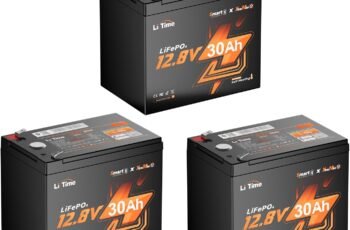
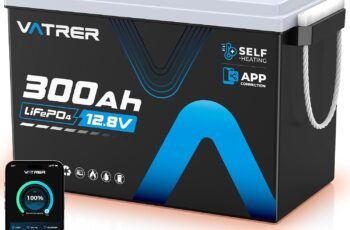
We find the LiTime 12V 460Ah Group 8D battery compelling for solar, RV, marine, and backup systems that need substantial reserve capacity. Its LiFePO4 cells provide 460Ah, while a 250A BMS regulates output and helps protect the battery. Capacity and discharge testing can help estimate runtime, though actual results depend on your loads and conditions. Before buying, we’d confirm dimensions, weight, charging requirements, temperature limits, price, and warranty. We’ll also examine its key advantages and trade-offs.
Key Takeaways
- The LiTime 12V 460Ah Group 8D LiFePO4 battery offers substantial reserve capacity for solar, RV, marine, cabin, and UPS systems.
- It uses EV-grade cells and a 250A BMS to regulate output and help protect the battery.
- Its rated capacity is usable above 12.8V; actual runtime varies with connected loads and operating conditions.
- Expansion is supported up to a 4P4S configuration, allowing larger systems for essential appliances and backup power.
- Before buying, confirm dimensions, weight, charging requirements, temperature range, price, charger compatibility, and warranty terms.
460Ah LiFePO4 Capacity
With 460Ah of LiFePO4 capacity, this battery provides substantial energy storage for extended use between charges. We can use its full rated capacity while voltage remains above 12.8V, supporting longer appliance runtime and fewer recharges.
Compared with lead-acid batteries, it offers nearly twice the usable energy, which can reduce charging frequency for equivalent loads. Capacity testing helps us assess available energy under defined conditions, while discharge curves show how voltage changes as the battery supplies power.
Together, these measures help you estimate runtime more accurately, though actual results depend on load, operating conditions, and the equipment connected to the battery.
Detailed features
Beyond its 460Ah capacity, the LiTime battery pairs EV-grade LiFePO4 cells with a 250A battery management system (BMS) that helps regulate power and protect the battery. We can summarize its key features and supported uses:
| Feature | Specification | Practical role |
|---|---|---|
| Cells | EV grade cells | Store and deliver energy |
| BMS | 250A protection | Regulates output and safeguards battery |
| Expansion | Up to 4P4S | Scales backup capacity |
| Applications | Solar, RVs, boats, UPS | Supports varied power systems |
For outages, we can use an expanded setup to power refrigerators, lighting, medical devices, and communications equipment. CE and RoHS compliance are also specified. AIG product liability insurance is effective May 22, 2026.
Pros and Cons
We’ll assess the LiTime battery’s advantages, including its 460Ah usable capacity, 250A BMS, and expandable configuration. We’ll also consider potential limitations in light of its intended applications and specifications.
This comparison will help you judge whether its strengths suit your power needs.
Pros
Although the LiTime 12V 460Ah Group 8D battery costs more upfront than a lead-acid option, its 100% usable capacity above 12.8V provides nearly twice the usable energy, extending appliance runtime and reducing recharges. We also value its EV-grade LiFePO4 cells and 250A battery management system, which support stable output and protect the battery.
Its Extended lifespan can reduce replacement frequency, while its lightweight design makes installation and handling easier than comparable lead-acid batteries. We can use it in solar systems, RVs, boats, cabins, and UPS setups, or expand backup capacity to 4P4S for essential appliances and communication equipment during outages.
Cons
The main drawback is the limited specification detail available: the provided information doesn’t state the battery’s dimensions, weight, charging requirements, or operating-temperature range, so we can’t assess fit and installation needs without checking the manufacturer’s documentation.
Its 460Ah capacity may also mean Limited portability; we should verify the battery’s weight and confirm that our vehicle, vessel, or mounting area can support it. The available information doesn’t disclose price, so we can’t determine whether premium pricing makes its capacity and EV-grade LiFePO4 cells worthwhile.
We should also confirm charger compatibility and warranty terms before purchase, despite its 250A BMS and CE and RoHS compliance.
Concluding thoughts
For systems that need substantial reserve capacity, the LiTime 12V 460Ah Group 8D battery offers 460Ah of usable capacity while maintaining voltage above 12.8V, supported by EV-grade LiFePO4 cells and a 250A BMS.
We’d consider it for solar, RV, marine, cabin, or UPS installations where longer runtime and fewer recharges matter. Its capacity can support essential loads, including refrigerators, lights, medical devices, and communications during outages.
Expansion up to 4P4S adds flexibility, though system design must match load and charging requirements. CE and RoHS compliance provide useful assurance. For long term reliability, we’d assess operating conditions and ownership experience over time.
Frequently Asked Questions
What Charging Profile Should I Use With This Battery?
We should follow LiTime’s manual; the provided specifications don’t state a charging profile. Confirm its recommended Charging Voltage and Charge Current with the manufacturer, and use a LiFePO₄-compatible charger with a 250A BMS limit.
Can This Battery Be Installed in Any Orientation?
Like a sealed toolbox, LiFePO4 batteries don’t vent gas during normal operation; however, we can’t confirm this model supports every position. Check its manual for approved Mounting orientation and Ventilation requirements before installation to promote safe operation.
What Cable Gauge and Fuse Rating Are Recommended?
For Cable Gauge Selection, we’d size conductors for current, run length, and voltage drop; the 250A BMS doesn’t specify cable gauge. For Fuse Sizing, we’d use manufacturer guidance and install appropriately rated overcurrent protection near the battery.
How Should I Store the Battery During Winter?
Like tucking away a tool, we should fully charge the battery, disconnect loads, and store it dry, cool, and above freezing. For winter storage, we’ll provide cold protection and check charge periodically.
Is Professional Installation Required for a Home Solar System?
Professional installation isn’t always required; we can install a home solar system ourselves if local codes allow. Check Home solar system permits first, and weigh DIY installation risks, including electrical hazards, inspection failures, and warranty issues.
Conclusion
We see a clear trade-off: the LiTime 12V 460Ah Group 8D battery offers substantial LiFePO4 capacity and 100% usable energy, while its size and weight demand careful planning. Its 250A BMS, EV-grade cells, and 4P4S expansion support a range of backup and off-grid applications, but we’d still match loads, charging equipment, and installation space to its specifications. For readers needing long runtimes, it’s a compelling option; for smaller setups, it may be more battery than necessary.