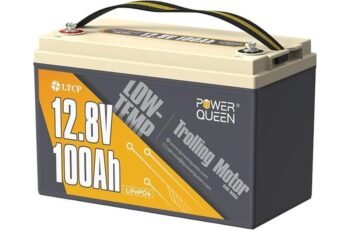
We find this 12V 100Ah LiFePO₄ battery a practical RV and solar deep-cycle option, offering 1,280Wh, a lightweight design, and a 100A BMS. Its claimed cycle life—over 4,000 cycles at full discharge—supports long-term use, while four-series, four-parallel compatibility allows system expansion. Actual runtime depends on load, conversion losses, and reserve capacity. The included 10A charger may recharge slowly, and cold-weather charging needs attention. We’ll examine its features, trade-offs, and installation checks next.
Key Takeaways
- The 12.8V, 100Ah battery stores 1,280Wh and suits RV, marine, and solar deep-cycle systems.
- Its LiFePO₄ cells weigh about one-third as much as an equivalent lead-acid battery.
- A 100A BMS protects against overcharging, over-discharging, overcurrent, and short circuits.
- Rated for over 4,000 full-depth cycles, it includes a five-year warranty and supports expansion up to 4S4P.
- Check cold-weather charging limits, the included 10A charger’s slow recharge rate, terminal fit, and system compatibility before installation.
RV Solar Battery Review
For an RV solar system, this 12.8V, 100Ah LiFePO₄ battery stores 1,280Wh and weighs far less than an equivalent lead-acid battery, making it easier to fit and carry.
We can use that capacity to estimate off grid runtime: divide 1,280Wh by your appliances’ combined wattage, then allow for conversion losses and reserve capacity. For example, a 100W load draws about 8.3 hours theoretically before losses.
Solar charging can replenish energy during daylight, but panel output, weather, and daily consumption determine whether the battery recovers fully. We should compare expected loads with available sunlight before choosing this battery for an RV setup.
Detailed features
Beyond its role in an RV solar setup, this battery’s key features determine how it performs and fits into a larger system. Its 12.8V, 100Ah capacity stores 1,280Wh, while Grade-A LiFePO₄ cells are rated for over 4,000 cycles at full discharge.
A Built in BMS monitors operation and guards against overcharging, over-discharging, overcurrent, and short circuits; temperature cutoff adds protection across changing conditions. At 10.82 × 9.25 × 6.49 inches, the battery has 8 mm terminals and integrated handles. We can connect up to four units in series and four in parallel, scaling a system to 48V and 400Ah.
Pros and Cons
We’ll weigh the battery’s long cycle life, built-in protections, and expansion options against its practical limitations.
We’ll also consider its weight and the conflicting weight figures in the product information. This comparison will help you judge whether it fits your setup.
Pros
If you’re replacing a lead-acid battery, this 12.8V, 100Ah LiFePO₄ model offers 1,280Wh of capacity at about one-third the weight. That Lightweight portability makes installation and handling easier in an RV or solar setup.
We get over 4,000 rated cycles at 100% depth of discharge, or up to 15,000 at 60%, supporting long cycle life under appropriate use. The built-in 100A BMS monitors operation and guards against overcharge, over-discharge, overcurrent, and short circuits.
We can also expand capacity through supported series or parallel connections, up to a 4S4P bank. A five-year warranty and included charger add practical value.
Cons
Despite its strong specifications, this battery has a few practical drawbacks. High upfront cost may deter buyers, especially when replacing a functioning lead-acid unit; we should compare the purchase price with expected cycle life and reduced weight before deciding.
Cold weather limitations also matter: the temperature cutoff protects cells but can restrict charging in freezing conditions, so RV owners may need a heated compartment or other safeguards.
The included 10A charger may recharge a depleted 100Ah battery slowly, and the 100A BMS limits sustained loads. We should also verify terminal fit, system compatibility, and the conflicting listed weights before installation.
Concluding thoughts
Overall, this 12.8V 100Ah LiFePO₄ battery offers 1,280Wh of capacity, a 100A BMS, and a lightweight design suited to RV, marine, and solar use. We’d consider it a practical lead-acid replacement when weight, cycle life, and protected operation matter.
Its stated cycle ratings and five-year warranty support long term reliability, though installation, charging, and temperature limits still require attention. The ideal user profile includes RV owners, boaters, and solar users needing a compact 12V deep-cycle supply.
You can expand capacity through supported series or parallel connections, but should verify system compatibility and charging requirements before building a larger bank.
Frequently Asked Questions
Can This Battery Power a Standard 12V Refrigerator Overnight?
Yes, we can likely power a standard 12V refrigerator overnight: this battery stores 1,280Wh. Check your refrigerator’s average consumption and Refrigerator startup surge; allow capacity for losses. Overnight temperature retention and cycling affect runtime, so verify actual draw.
How Long Does the Included Charger Take to Recharge the Battery?
The included 10A charger needs roughly 10–12 hours to recharge a fully depleted 100Ah battery; actual Charger recharge time varies with starting charge and charging losses. We recommend allowing extra time for complete Charging duration.
Can I Connect This Battery to an Existing Lead-Acid Battery Bank?
We wouldn’t connect this LiFePO₄ battery directly to an existing lead-acid bank. Voltage compatibility alone isn’t enough; different charging profiles can cause problems. Use charging isolation, such as a suitable DC-to-DC charger, and verify system specifications first.
What Solar Charge Controller Settings Are Recommended for This Battery?
Set Absorption voltage to 14.4–14.6V and Float voltage to 13.4–13.6V; precision matters more than guesswork. We’d disable equalization and temperature compensation, confirm your controller supports lithium, and follow the manufacturer’s limits for safe charging.
Is the Battery Safe to Install Inside an RV Living Area?
Yes, we can install this LiFePO₄ battery inside an RV living area, but we should choose a secure, dry Installation Location and follow manufacturer Ventilation Requirements, clearance, temperature, wiring, and terminal-protection guidance. Its BMS adds protection, not installation safeguards.
Conclusion
We’d consider this 12V 100Ah LiFePO₄ battery a practical RV solar upgrade: its 1,280Wh capacity, 100A BMS, temperature cutoff, and Grade-A cells support dependable deep-cycle use. The included charger and Anderson plug simplify setup, while 4S4P expansion leaves room to grow. Before buying, we’d verify the conflicting weight listing and confirm terminal, charging, and load compatibility. With those checks complete, its five-year warranty and cycle rating offer a solid foundation for longer trips beyond the campground.