LiTime 12V 100Ah Battery: Quick Overview
Can a $319.99 lithium battery deliver a worthwhile upgrade over a Group AGM battery for an RV, van, boat, or off-grid system? The LiTime 12V 100Ah battery makes a strong paper case: it is a 12V 100Ah LiFePO4 energy-storage battery with stated 1,280Wh energy and 100% usable capacity. That is considerably more usable energy than the 70Ah AGM comparison given in the listing, although installation details still need checking.
The LiTime 12V 100Ah battery is intended for RV house power, camper vans, boats, solar storage, home backup, and 30–70 lb trolling motors. It is not a starting battery, golf-cart battery, or jack battery, so we would not use it for engine cranking or equipment outside its stated energy-storage role.
The current listed price is $319.99, and availability is shown as In Stock. In 2026, that price looks competitive on the stated capacity and BMS specification, but omitted technical details prevent us from calling it an automatic bargain. The LiTime 12V 100Ah battery deserves consideration if we need a Group 24-style replacement and future expansion, provided the charger, enclosure, terminals, and load profile all match.
We assess fit, usable energy, BMS protection, maintenance, expansion, customer-feedback evidence, alternatives, and buyer suitability here. We do not present unsupported hands-on testing or guaranteed runtime figures.

Key Specifications and Group Fit
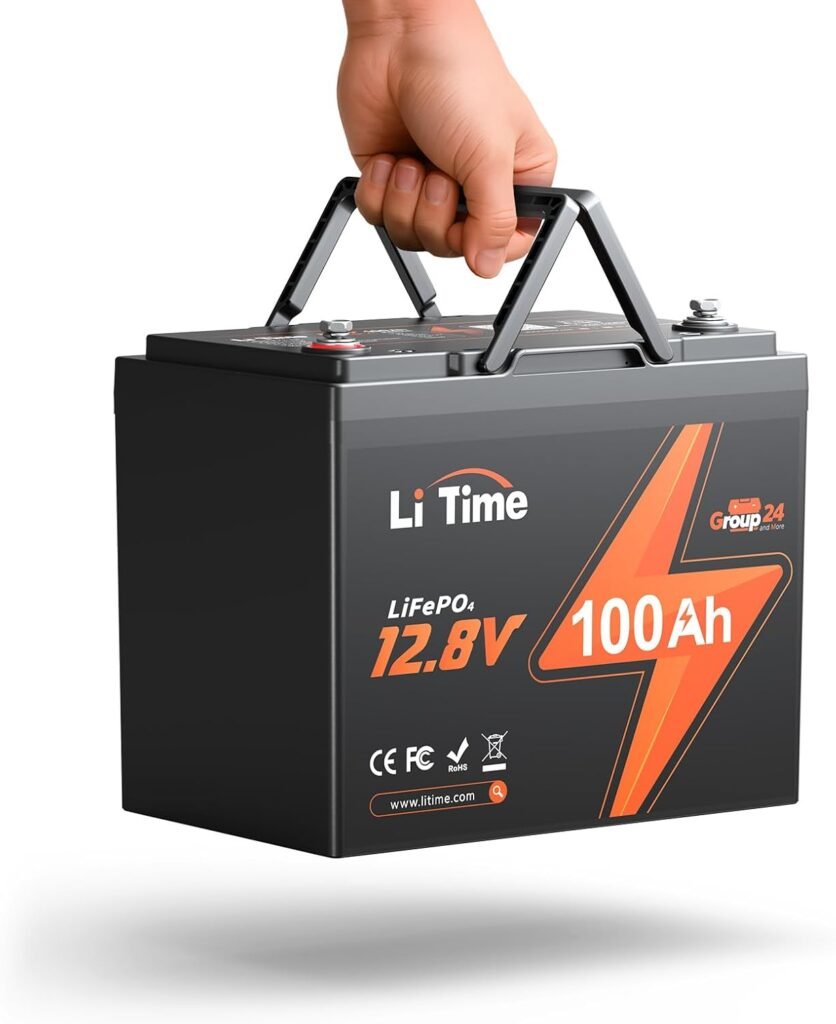
The central practical claim is a universal-fit, drop-in replacement for a Group AGM battery. For the LiTime 12V 100Ah battery, “drop-in” means the maker intends it to fit standard Group boxes and connect with existing RV, marine, van, or solar wiring without extra wiring in a compatible installation. That describes the intended format, not a promise that every enclosure or electrical system will match.
| Specification | Stated detail |
|---|---|
| Nominal voltage | 12V |
| Capacity | 100Ah |
| Energy | 1,280Wh, 100% usable |
| Battery management system | 100A BMS |
| Chemistry | LiFePO4 |
| Fit | BCI Group universal-fit design |
| Cycle-life claim | 4,000+ deep cycles |
| Price and availability | $319.99; In Stock |
Physical compatibility and electrical compatibility are different questions. Before buying the LiTime 12V 100Ah battery, we would check the existing group size, measure the box and clearance, confirm the system voltage, inspect terminal placement, verify cable sizing and fuse protection, and confirm that the charger has a LiFePO4 profile.
The supplied description does not give exact dimensions, weight, terminal type, charge-rate limits, discharge-rate limits beyond the 100A BMS reference, or operating-temperature limits. We should verify those details on the current listing or manual rather than assume that a Group label answers everything.
- Identify the present battery group size.
- Inspect the box, terminals, cables, and available clearance.
- Confirm the system is designed for 12V lithium operation.
- Check charger compatibility and expected loads.
LiTime 12V 100Ah Battery Energy and Runtime
The LiTime 12V 100Ah battery is advertised with 1,280Wh of energy and 100% usable capacity. A simple estimate is watt-hours ÷ appliance watts, followed by an allowance for inverter, cabling, and conversion losses. The calculation is useful for planning, but it is not a guaranteed runtime because appliances cycle, battery voltage changes, and system losses vary.
For example, a continuous 100W load would theoretically use 1,280Wh in about 12.8 hours before losses. A 500W load would theoretically use the same stated energy in about 2.56 hours. Those figures should be treated as upper-level arithmetic rather than promises of measured performance.
The listing compares this capacity with a 70Ah AGM battery supplying 504Wh at 60% depth of discharge. This is why usable energy matters more than the headline amp-hour number: a lithium battery and a lead-acid battery may carry similar voltage labels while offering different practical energy. The LiTime 12V 100Ah battery may therefore suit LED lighting, a water pump, refrigerator, ventilation fan, router, and modest inverter use, but high-wattage appliances can consume 100Ah quickly.
To plan properly, list every appliance, record its wattage, estimate daily operating hours, multiply watts by hours, total the watt-hours, and add a reserve. If the result approaches the battery’s stated energy, consider a second battery or lower-power equipment. That exercise is more reliable than choosing solely by amp-hours.
Grade-A LiFePO4 Cells, Cycle Life, and Maintenance
The LiTime 12V 100Ah battery is described as using Grade-A LiFePO4 cells. Lithium iron phosphate chemistry is commonly chosen for recreational and stationary storage because it is designed for repeated cycling and does not require the routine water topping-up associated with many flooded lead-acid batteries. It still requires a lithium-compatible charging system.
The advertised figure is 4,000+ deep cycles, while the description also refers to a 10-year life. We should treat both as manufacturer claims, not guarantees. Actual service life depends on charging voltage, depth of discharge, temperature, storage conditions, and the pattern and size of connected loads. A cycle-life number also does not establish exactly how much capacity remains at the end of that period.
Moderate cycling and avoiding unnecessary deep discharge can help preserve capacity, but lithium is not maintenance-free in the sense of being installation-free. The LiTime 12V 100Ah battery should be paired with the correct charger, protected from prolonged full-charge storage in hot conditions, and isolated from parasitic loads during long periods out of service.
Our storage routine would be straightforward:
- Charge according to the current manual.
- Disconnect or isolate the battery from the vehicle and other loads.
- Store it in a dry location with moderate temperatures.
- Check its state periodically and recharge only as directed.
This approach gives the claimed service-life figures a sensible operating context without promising that every unit will reach ten years.

100A BMS Protection and First-Use Setup
A built-in 100A battery-management system is specified for the LiTime 12V 100Ah battery. The listed protections cover overcharge, over-discharge, short circuit, and overheating. In practical terms, the BMS monitors and protects the cells, but it is not a substitute for a correctly sized fuse, suitable cables, a compatible charger, secure connections, and safe installation.
A 100A BMS suggests that the battery may support substantial 12V loads, yet we should not interpret that number as permission to draw 100A continuously in every setup. The battery’s continuous-discharge specification, inverter limit, cable rating, fuse rating, and equipment requirements all need confirmation from the current documentation.
The listing says Bluetooth activation may require charging with a lithium-activation or MPPT charger on first use or after the battery has been switched off. It does not establish that Bluetooth monitoring, cold-weather charging, or automatic low-temperature cutoff is included, so we would not assume those functions.
For first use, we would:
- Inspect the case and terminals for visible damage.
- Install the correct positive-side fuse with the system de-energized.
- Connect the positive and negative cables securely.
- Charge fully with a LiFePO4-compatible charger.
- Test intended loads gradually while checking for unexpected shutdowns.
That sequence keeps the LiTime 12V 100Ah battery within the role described by the manufacturer rather than treating the BMS as the entire electrical safety system.
Expansion to 20.48kWh for Larger Systems
The LiTime 12V 100Ah battery is described as expandable to a maximum 4P4S arrangement: four parallel strings and four series positions, producing a stated 51.2V 400Ah configuration with up to 20.48kWh of energy. That figure applies to the described maximum configuration, not to the single $319.99 battery supplied in the basic purchase.
Parallel connections increase capacity, while series connections increase voltage. The finished arrangement must match the inverter, charge controller, battery protection, disconnects, busbars, and wiring. A 12V RV installation and a 51.2V home-backup bank are not interchangeable simply because they use the same battery modules.
Expansion is not just a matter of connecting batteries together. We would match model, age, state of charge, and condition, then use appropriate fusing, busbars, disconnects, cable lengths, and system-level protection. Adding a second unit may be realistic for longer RV stays or increased solar storage; a larger bank may suit home backup or an off-grid installation.
Before expanding the LiTime 12V 100Ah battery system, we would obtain the manufacturer’s approved wiring diagram and ask whether four-battery configurations require balancing, commissioning, or additional monitoring. We would also verify that the charger and inverter are configured for the final voltage. The 20.48kWh ceiling is useful planning information, but it should not be mistaken for immediately available capacity.
What Customers Are Saying
The supplied product data does not include a verified star rating, review count, or a complete set of current customer comments, so we cannot responsibly claim that buyers broadly praise or criticise the LiTime 12V 100Ah battery. We also cannot invent failure rates, measured runtimes, charging times, or long-term reliability results. That limitation matters: immediate installation impressions are weaker evidence than reports covering repeated camping trips, seasonal storage, or sustained solar use.
When reviewing the current listing, we would look for recurring details rather than isolated opinions. Useful comments identify the previous battery type, appliances powered, charger or solar controller model, ambient temperature, measured voltage, and time in service. Reports about easy installation or lower weight may help judge convenience, while repeated accounts of BMS shutdowns or charging problems need context.
Conflicting feedback should be examined carefully. Complaints may relate to an unsuitable charger, starting-battery use, cold-weather charging, incorrect wiring, inadequate fusing, or loads beyond the intended energy-storage role. A comment that says only “dead after a month” tells us much less than one explaining the charge profile, storage conditions, and connected equipment.
Our review-reading method is practical: sort by newest comments, inspect critical reviews, identify repeated patterns, discount vague one-line statements, and compare each claim with the published specifications. For the LiTime 12V 100Ah battery, that process is especially important because several technical details remain unspecified in the supplied description.
LiTime 12V 100Ah Battery Compared With Alternatives
The LiTime 12V 100Ah battery sits alongside the Weize 12V 100Ah LiFePO4 Battery and the CHINS 12V 100Ah LiFePO4 Battery as alternatives worth checking. We should compare like-for-like listings because price, included accessories, warranty terms, monitoring features, and specifications can change by seller, bundle, or promotion. The supplied data does not provide current prices for either alternative, so we will not manufacture them.
| Comparison point | LiTime | Weize | CHINS |
|---|---|---|---|
| Stated energy | 1,280Wh | Confirm current listing | Confirm current listing |
| Chemistry | LiFePO4 | LiFePO4 | LiFePO4 |
| BMS | 100A; protections listed | Confirm details | Confirm details |
| Cycle-life claim | 4,000+ cycles | Confirm claim | Confirm claim |
| Expansion | 4P4S described | Confirm compatibility | Confirm compatibility |
| Monitoring and warranty | Confirm current terms and Bluetooth functions | Confirm listing | Confirm listing |
| Price | $319.99 | Confirm current price | Confirm current price |
Amp-hours alone do not decide value. We would compare usable watt-hours, charger compatibility, protection features, support, return terms, physical fit, and the cost of adding a second battery. The LiTime model is most compelling when we specifically want its stated Group format, usable energy, 100A BMS, and expansion path.
Buyers with unusual enclosure dimensions or specialized monitoring needs should verify the Weize and CHINS specifications line by line. The LiTime 12V 100Ah battery is a reasonable starting point for standard replacement projects, but an alternative may be better if it supplies clearer measurements, more suitable monitoring, or stronger documented support for the intended installation.
Who Should Buy This Battery?
The strongest fit for the LiTime 12V 100Ah battery is an RV owner replacing a Group AGM battery, a van camper wanting more usable energy in a similar intended format, a boater running house loads, or an off-grid user building a 12V solar-storage system. The stated 1,280Wh energy, maintenance-free cycling, 100A BMS, and expansion path make the specification appealing for moderate daily demand.
The listing also names 30–70 lb trolling motors. We would treat that as a starting point for investigation rather than universal compatibility. Confirm the motor voltage, peak current, connector arrangement, expected operating time, and whether the battery is approved for that specific motor before relying on it on the water.
Poor fits include vehicles needing engine-starting power, golf carts, jacks, and systems that cannot use lithium charging profiles. Buyers who need exact cold-weather charging limits should also pause until those details are confirmed. The LiTime 12V 100Ah battery is intended for energy storage, not every 12V application.
Our decision sequence would be:
- Confirm the use case and daily watt-hours.
- Check the Group enclosure and terminal arrangement.
- Verify charger compatibility and protection requirements.
- Review any planned expansion.
- Compare the final installed cost, including cabling and hardware.
One unit may be insufficient for electric heating, induction cooking, air conditioning, or large inverters used for extended periods. Those loads deserve a full energy audit before purchase.
Price, Value, and Buying Checklist for 2026
At the listed $319.99, the LiTime 12V 100Ah battery offers a stated 1,280Wh, 100% usable energy, a 100A BMS, a Group replacement format, and a 4,000+ deep-cycle claim. Dividing price by stated energy gives an indicative upfront cost of about $0.25 per Wh. That is a comparison figure, not a complete cost-of-ownership calculation.
Installation may add the cost of a lithium-compatible charger, fuse, cabling, disconnect, or enclosure changes. A future second battery also changes the project budget. Compared with AGM, we would assess usable capacity and expected cycling alongside purchase price, weight, maintenance, charging efficiency, and likely replacement frequency rather than choosing solely on the initial ticket.
The listing states that AIG Product Liability Insurance protection is effective from May 22, 2026. We would read the exact coverage terms and keep that separate from the product warranty, return policy, and any technical-support commitments. Liability insurance does not automatically explain what happens if a battery fails or arrives damaged.
Before ordering the LiTime 12V 100Ah battery, we would complete this check in order:
- Confirm the current price and In Stock status.
- Verify dimensions, terminals, and clearance in the current listing or manual.
- Check warranty and return terms.
- Confirm charging limits and temperature guidance.
- Inspect recent critical-review trends.
- Match the battery to the intended load and final installed cost.
Our buying takeaway is balanced: this is most compelling as a Group 24-style energy-storage replacement with meaningful stated usable capacity, but omitted technical details should be verified before placing an order.
Pros and Cons
Pros
- Stated 1,280Wh of energy with 100% usable capacity
- Group universal-fit replacement design for intended RV, marine, van, and solar applications
- 100A BMS with listed overcharge, over-discharge, short-circuit, and overheating protection
- Advertised 4,000+ deep-cycle life and Grade-A LiFePO4 cells
- Expansion is described up to a 4P4S, 51.2V 400Ah, 20.48kWh configuration
Cons
- Exact dimensions, weight, terminal type, charge limits, and temperature limits are not supplied in the provided product data
- The battery is not suitable for engine starting, golf carts, or jacks
- Bluetooth activation may require a lithium-activation or MPPT charger
- The cycle-life and 10-year figures are claims rather than guaranteed service-life results
- A single 100Ah battery may not support extended high-wattage heating, cooking, air-conditioning, or large-inverter loads
Final Verdict
Key Takeaways
- The battery is listed at $319.99 with 1,280Wh of stated energy, 100% usable capacity, LiFePO4 chemistry, and a 100A BMS.
- Its intended role is 12V energy storage for RVs, vans, boats, solar systems, home backup, and specified trolling motors—not engine starting, golf carts, or jacks.
- The Group replacement claim helps with physical fit, but charger settings, terminals, cable sizing, fusing, and omitted technical details still require confirmation.
- The 4,000+ cycle, 10-year life, and 20.48kWh expansion figures are manufacturer claims or maximum configuration descriptions, not guarantees for a single battery.
- It is most suitable for moderate 12V loads and shoppers planning a compatible Group 24-style replacement or expandable storage system.
Frequently Asked Questions
What is the best 300Ah lithium battery for an RV?
There is no single best 300Ah lithium battery for every RV. We would compare usable watt-hours, BMS rating, dimensions, charger compatibility, warranty, cold-weather guidance, and expansion support against the RV’s actual loads; the reviewed product is a 100Ah battery, not a 300Ah model.
How long will a 12V 300Ah battery last?
Runtime depends on the battery’s watt-hours and the connected load. Use watt-hours divided by appliance watts, then allow for inverter and wiring losses; a 300Ah battery at a nominal 12V is often discussed as roughly 3,600Wh, but the manufacturer’s usable-energy specification and real load profile should determine the estimate.
What is the best LiFePO4 battery on Amazon?
The best choice depends on fit, energy demand, charger compatibility, BMS protection, warranty, monitoring, and documented temperature limits. For a Group 24-style 12V energy-storage replacement, this LiTime model is worth comparing because its listing states 1,280Wh, 100% usable energy, and a 100A BMS.
What is the price of a 12V 300Ah LiFePO4 Lithium Battery?
Pricing varies by brand, seller, promotion, warranty, and included equipment, so there is no dependable single price without checking the current listing. The product reviewed here is a 12V 100Ah model listed at $319.99, not a 300Ah battery.