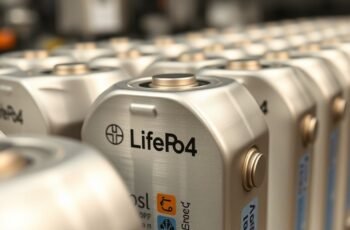
Few realize that the stability of a LiFePO4 battery comes from its unique crystal structure, which resists thermal runaway. This structure enables safe, long-lasting operation, but understanding how it functions at the chemical level reveals the true advantages and limitations of this chemistry. By examining its components and their interactions, we can better appreciate why LiFePO4 is increasingly favored in energy storage. The details behind its chemistry are essential to grasp for anyone evaluating its performance and safety.
Key Takeaways
- LiFePO4 is a cathode material based on lithium iron phosphate, providing high stability and safety in battery chemistry.
- During charge/discharge, lithium ions shuttle between the graphite anode and LiFePO4 cathode.
- The phosphate-based cathode’s strong covalent bonds prevent lattice degradation, enhancing longevity.
- The electrolyte typically contains lithium salts in organic solvents, facilitating ionic movement while maintaining stability.
- LiFePO4 batteries offer flat voltage profiles, high thermal stability, and lower risk of thermal runaway.
What Is LiFePO4 Battery Chemistry and How Does It Work?
LiFePO4 batteries, also known as lithium iron phosphate batteries, operate through a specific electrochemical process that involves the movement of lithium ions between the cathode and anode during charge and discharge cycles. This process is characterized by the stable crystal structure of the phosphate compound, which enhances safety and longevity. The manufacturing processes for LiFePO4 cells are designed to minimize environmental impact by reducing toxic waste and energy consumption, though they still involve resource extraction and processing. During operation, lithium ions shuttle between the electrodes, storing and releasing energy efficiently. This chemistry results in a battery with high thermal stability, long cycle life, and a relatively lower environmental footprint compared to other lithium-ion chemistries, making it increasingly attractive for sustainable energy storage solutions.
The Chemical Composition of LiFePO4 Batteries Explained
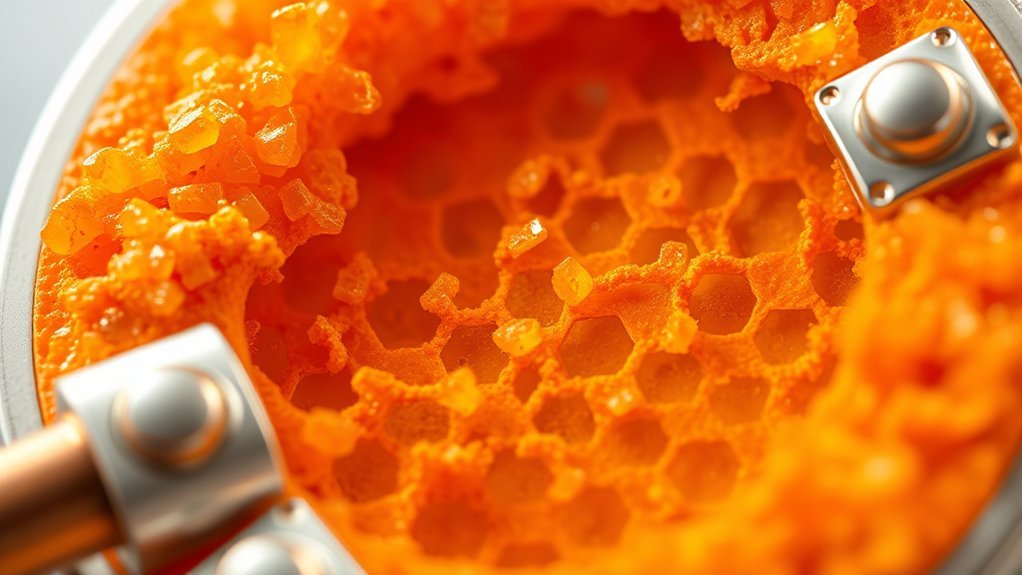
Understanding the chemical composition of LiFePO4 batteries involves examining their core materials and how they interact to store and release energy. The electrode materials consist of a lithium iron phosphate cathode and a carbon-based anode, both critical in electrochemical reactions. Manufacturing processes influence the purity and structure of these components, impacting performance. The cathode’s crystalline structure ensures stability and safety, while the anode’s porous carbon enhances conductivity. The table below summarizes the key components:
| Material | Role | Manufacturing Considerations |
|---|---|---|
| Lithium Iron Phosphate (LiFePO4) | Cathode material, energy storage | Crystalline structure, purity control |
| Carbon (graphite) | Anode material, electron flow | Porosity, particle size |
| Binder | Electrode integrity | Adhesion quality |
| Conductive Additives | Improve electrical conductivity | Dispersion and uniformity |
| Separator | Prevents short circuits | Thickness, chemical stability |
How Lithium Iron Phosphate Cathodes Improve Safety and Stability

The inherent chemical properties of lithium iron phosphate contribute considerably to the enhanced safety and stability of these batteries. Unlike other cathode materials, LiFePO4’s stable crystal structure minimizes thermal runaway risks, making it less prone to overheating or combustion during abuse conditions. This stability benefits battery manufacturing by reducing the need for complex safety mechanisms. Additionally, the safety profile facilitates easier recycling techniques, as LiFePO4 batteries generate fewer hazardous byproducts. The structural integrity of the cathode also ensures consistent performance over many charge cycles, further supporting stability. Overall, the chemical resilience of lithium iron phosphate enhances both operational safety and environmental handling, making it a preferred choice in applications demanding reliability and sustainable disposal practices.
The Role of Graphite Anodes in LiFePO4 Battery Chemistry
Graphite anodes facilitate lithium intercalation, enabling efficient charge/discharge cycles within LiFePO4 batteries. Their stability under repeated cycling directly influences overall battery longevity and performance consistency. Analyzing these interactions helps optimize anode design for enhanced durability and safety.
Graphite’s Lithium Intercalation
How does graphite function as an anode in LiFePO4 batteries? Its role hinges on lithium intercalation within the graphite structure. During charging, lithium ions migrate from the cathode and intercalate between graphite layers, forming lithium-graphite compounds. The layered Graphite structure facilitates this process, providing accessible interlayer spaces for lithium insertion. Lithium mobility within graphite is essential; it must be sufficiently rapid to enable efficient charge transfer without degrading the anode. The well-ordered layers allow for reversible intercalation and deintercalation, ensuring longevity and cycle stability. Precise control of lithium’s movement within the graphite matrix directly influences battery performance, capacity retention, and charging rates. This dynamic interplay underscores graphite’s critical function as a reversible host for lithium in LiFePO4 battery systems.
Anode Stability Contributions
Although graphite’s layered structure enables efficient lithium intercalation, its contribution to anode stability in LiFePO4 batteries extends beyond mere storage capacity. As an anode material, graphite provides a stable platform that maintains structural integrity during charge and discharge cycles, minimizing volume changes that could compromise performance. Its electrochemical properties help buffer the interface between the electrode and electrolyte, promoting electrolyte stability by reducing the formation of unstable solid-electrolyte interphase (SEI) layers. This stability is essential for preventing degradation pathways that could lead to capacity fade or safety issues. By ensuring a consistent and resilient anode structure, graphite enhances overall cell stability, supporting reliable operation under various operating conditions without sacrificing the fundamental electrochemical balance in LiFePO4 systems.
Impact on Battery Longevity
What makes graphite an essential component in extending the lifespan of LiFePO4 batteries? Its stable electrochemical properties enable consistent charge-discharge cycles, minimizing degradation. Graphite’s layered structure facilitates efficient intercalation, reducing mechanical stress on the anode and enhancing cycle life. From an environmental impact perspective, graphite’s abundance and relatively straightforward manufacturing processes contribute to lower ecological footprints compared to alternative anode materials. Additionally, advancements in manufacturing processes, such as controlled particle size and purity, improve anode stability, directly influencing battery longevity. These factors collectively guarantee that graphite anodes maintain structural integrity over numerous cycles, leading to longer-lasting batteries. Consequently, the integration of high-quality graphite optimizes both the performance and environmental sustainability of LiFePO4 batteries.
Understanding the Electrolyte in LiFePO4 Batteries and Its Function
The electrolyte in LiFePO4 batteries plays a crucial role in facilitating ionic movement between the cathode and anode during charge and discharge cycles. Its composition typically includes a lithium salt, such as LiPF6, dissolved in an organic solvent mixture, ensuring efficient ion transport. The chemical stability of this electrolyte is vital, as it must withstand operational voltages without decomposing, which can compromise battery safety and performance. A stable electrolyte prevents parasitic reactions, maintains conductivity, and supports consistent cycling. Precise formulation balances ionic conductivity with chemical inertness, minimizing degradation over time. Understanding the electrolyte’s composition and its chemical stability helps us optimize battery longevity, safety, and overall efficiency, making it a key element in the advanced chemistry of LiFePO4 batteries.
Why LiFePO4 Batteries Have a Longer Lifespan Compared to Other Lithium-Ion Batteries
We observe that LiFePO4 batteries have a more stable chemical structure, which reduces the formation of degradation products during cycling. This stability minimizes capacity loss over time, extending their operational lifespan. Consequently, their reduced degradation rates make them a more durable choice compared to other lithium-ion chemistries.
Stable Chemical Structure
LiFePO4 batteries are renowned for their extended lifespan, largely due to their stable chemical structure. This stability stems from the inherent properties of their electrode materials, which resist structural changes during charge and discharge cycles. The phosphate-based cathode exhibits robust covalent bonds that prevent lattice degradation, unlike other lithium-ion chemistries. Additionally, manufacturing processes optimize the uniformity of electrode materials, reducing defect formation and enhancing structural integrity over time. This chemical stability minimizes capacity fade and thermal runaway risks. The crystalline structure of LiFePO4 maintains its integrity under repeated cycling, contributing to longer cycle life. Overall, the combination of resilient electrode materials and precise manufacturing guarantees a stable chemical framework that underpins the battery’s durability and longevity.
Reduced Degradation Rates
Why do LiFePO4 batteries exhibit considerably lower degradation rates compared to other lithium-ion chemistries? Their stable chemical structure resists capacity fade over multiple cycles, extending lifespan. This stability results in fewer side reactions during charge/discharge, reducing electrode degradation. Consequently, LiFePO4 batteries maintain performance longer, decreasing the frequency of replacement and facilitating more sustainable battery recycling. Their durability also lessens environmental impact by reducing waste and resource extraction.
| Factor | Impact on Degradation Rate |
|---|---|
| Chemical Stability | Minimizes side reactions, prolongs life |
| Thermal Stability | Prevents overheating, reduces damage |
| Structural Integrity | Limits electrode breakdown, maintains capacity |
| Cycling Tolerance | Handles deep cycles without significant wear |
| Environmental Impact | Less frequent replacements, easier recycling |
The Impact of Battery Chemistry on Charging and Discharging Performance
The chemistry of a battery fundamentally determines its ability to efficiently charge and discharge under various conditions. In Lifepo4 batteries, this chemistry offers stable voltage profiles and high current handling, vital for microgrid applications and renewable integration. The inherent safety and long cycle life enhance performance stability during rapid charge/discharge cycles.
- Lithium iron phosphate’s high thermal stability minimizes risks during high current flows
- Its flat voltage curve simplifies state-of-charge estimation
- Low internal resistance improves efficiency in energy transfer
- Consistent performance under diverse temperature ranges supports renewable energy systems
These attributes guarantee Lifepo4 batteries deliver reliable, predictable energy flow, essential for effective microgrid operations and optimizing renewable energy utilization.
Common Chemical Challenges in LiFePO4 Batteries and How They Are Addressed
Despite their many advantages, LiFePO4 batteries face specific chemical challenges that can affect performance and lifespan. One key issue involves managing the stability of the cathode during charge and discharge cycles, which can lead to capacity fade. Manufacturing processes and battery packaging techniques are tailored to mitigate such effects, ensuring uniform electrode materials and preventing degradation. Additionally, the formation of a stable solid electrolyte interphase (SEI) on the anode helps prevent unwanted side reactions.
| Challenge | Impact | Mitigation Strategy |
|---|---|---|
| Cathode stability | Capacity loss over cycles | Precise manufacturing controls |
| SEI formation | Reduced efficiency and lifespan | Optimized electrolyte composition |
| Mechanical stress in packaging | Cracking and degradation of materials | Advanced battery packaging design |
Comparing LiFePO4 Chemistry to Other Lithium-Ion Chemistries: Key Differences
When comparing LiFePO4 to other lithium-ion chemistries, differences in energy density markedly impact their suitability for various applications. Thermal stability varies considerably, with LiFePO4 offering superior safety margins, while lifespan and durability metrics influence long-term performance. Analyzing these key distinctions helps optimize battery selection based on specific operational demands.
Energy Density Variations
How does the energy density of LiFePO4 compare to other lithium-ion chemistries, and what are the implications for their applications? LiFePO4 typically exhibits a lower energy density—around 90–160 Wh/kg—compared to nickel-based chemistries like NMC or NCA, which can reach 200–250 Wh/kg. This difference impacts applications requiring compact, high-capacity batteries, favoring other chemistries. However, LiFePO4’s material sustainability offers advantages, including longer cycle life and enhanced safety, which can offset the lower energy density in specific contexts.
- The trade-off between energy density and safety
- Material sustainability’s role in eco-friendly designs
- Impact on portable versus stationary applications
- The importance of energy density in system design
Thermal Stability Differences
LiFePO4 batteries exhibit markedly superior thermal stability compared to other lithium-ion chemistries such as NMC or NCA. This stability stems from their robust crystal structure, which resists thermal runaway—a dangerous chain reaction triggered by excessive heat or internal faults. LiFePO4’s lower operating temperature profile facilitates effective heat dissipation, reducing the risk of overheating. Unlike NMC or NCA batteries, which can experience rapid temperature increases leading to critical failure, LiFePO4’s thermal properties promote safer operation under stress. The material’s inherent stability prevents aggressive reactions during thermal events, making it less prone to catastrophic failure. Consequently, LiFePO4 batteries excel in applications requiring high safety margins, particularly where heat management and thermal runaway mitigation are paramount.
Lifespan and Durability
Compared to other lithium-ion chemistries such as NMC and NCA, LiFePO4 batteries generally offer a considerably longer lifespan and enhanced durability. This is due to their stable crystal structure, which minimizes capacity fade over cycles. They typically endure 2,000 to 3,000 charge cycles, surpassing NMC/NCA batteries. Their thermal stability reduces degradation caused by overheating, improving safety and longevity. Additionally, LiFePO4’s chemical stability facilitates easier battery recycling, reducing environmental impact. These factors contribute to lower replacement frequency and less waste.
- Higher cycle life translates to fewer replacements and less environmental waste
- Greater thermal stability minimizes degradation and safety risks
- Stable chemistry enhances the feasibility of recycling processes
- Improved durability supports sustainable energy storage solutions
How Battery Chemistry Influences the Safety, Cost, and Sustainability of LiFePO4 Batteries
The chemistry of lithium iron phosphate (LiFePO4) fundamentally shapes the safety, cost, and sustainability profiles of these batteries. Its stable molecular structure reduces the risk of thermal runaway, enhancing safety during operation and manufacturing. This intrinsic stability also simplifies battery manufacturing, lowering production costs by minimizing the need for complex safety systems. From an environmental perspective, LiFePO4’s non-toxic composition results in a lower environmental impact, as it avoids hazardous materials found in other chemistries. Additionally, its long cycle life promotes sustainability by reducing the frequency of replacements and waste. Overall, the specific chemistry of LiFePO4 supports safer, more cost-effective, and environmentally responsible energy storage solutions, making it a strategic choice for applications prioritizing safety and ecological considerations.
Frequently Asked Questions
How Does Temperature Affect Lifepo4 Battery Performance?
Temperature effects profoundly influence Lifepo4 battery performance stability; high temperatures accelerate degradation, reducing lifespan, while low temperatures impair capacity and efficiency. We analyze these impacts to optimize operational conditions and extend battery longevity.
What Are the Environmental Impacts of Lifepo4 Battery Manufacturing?
We recognize that Lifepo4 battery manufacturing impacts the environment through resource extraction and emissions; however, we prioritize eco-friendly manufacturing practices and supply chain sustainability to minimize ecological footprints and promote responsible industry standards.
Can Lifepo4 Batteries Be Recycled Effectively?
We believe LiFePO4 batteries can be effectively recycled through specialized recycling processes that recover valuable materials. These processes address environmental considerations by minimizing waste and reducing ecological impact, making LiFePO4 recycling both feasible and environmentally responsible.
How Does the Energy Density of Lifepo4 Compare to Other Chemistries?
We find that Lifepo4’s energy density is lower than lithium-ion chemistries like NMC or NCA, yet it excels in safety and lifespan. This chemistry comparison emphasizes durability over compactness, ideal for long-term, reliable energy storage solutions.
Are There Any Specific Maintenance Requirements for Lifepo4 Batteries?
We recommend following specific charging protocols to optimize battery lifespan and minimize capacity fade. Regular monitoring and avoiding deep discharges are essential, ensuring longevity and reliable performance for Lifepo4 batteries over their operational life.
Conclusion
In the end, our thorough exploration of LiFePO4 chemistry reveals it’s almost too good—safe, stable, and long-lasting. Yet, ironically, its very resilience can mask the complex chemistry at play. While it may seem straightforward, this chemistry’s robustness underscores the importance of understanding material interactions. So, next time you rely on LiFePO4, remember: behind that calm stability lies a sophisticated dance of ions and electrons—an elegant, if understated, feat of chemical engineering.