If you’ve ever underestimated the complexity of modern energy storage, you’re in for a surprise—LiFePO4 batteries are far more sophisticated than their reputation suggests. These advanced cells combine safety, longevity, and efficiency in ways that can substantially impact your projects or systems. Understanding their intricacies is essential for making informed decisions, yet many overlook critical details that could compromise performance. So, let’s explore what makes LiFePO4 batteries a compelling choice and why they might be the right solution for you.
Key Takeaways
- Lifepo4 batteries use lithium iron phosphate chemistry for safer, more stable, and environmentally friendly energy storage.
- They offer long cycle life, often over 2,000 cycles, making them ideal for solar, EVs, and portable devices.
- Proper maintenance includes avoiding overcharging, deep discharges, and storing at 50% charge in cool, dry conditions.
- They are safer due to high thermal stability, reducing risks of thermal runaway and fire hazards.
- Recycling and responsible disposal are essential to minimize environmental impact and recover valuable materials.
What Are Lifepo4 Batteries and How Do They Work?
LiFePO4 batteries, also known as lithium iron phosphate batteries, are a specific type of rechargeable lithium-ion battery distinguished by their cathode chemistry, which uses lithium iron phosphate. This chemistry offers enhanced thermal stability and safety, reducing risk of thermal runaway. Internally, they operate through lithium-ion transfer between the anode and cathode during charge and discharge cycles. Their longevity, often exceeding 2,000 cycles, minimizes waste and supports sustainable battery recycling practices. Their environmentally friendly design results in a lower environmental impact compared to other lithium-ion chemistries, as they contain no cobalt or nickel, reducing toxic waste. Proper battery recycling is essential to recover valuable materials and prevent environmental contamination, making LiFePO4 batteries a more eco-conscious choice for energy storage solutions.
Benefits of Using Lifepo4 Batteries Over Other Types

The advantages of LiFePO4 batteries become evident when compared to other common lithium-ion chemistries such as lithium cobalt oxide (LCO), lithium manganese oxide (LMO), or lithium nickel manganese cobalt oxide (NMC). Their inherently stable chemical structure provides a longer cycle life and improved thermal stability, reducing risks of thermal runaway. This stability also enhances safety during operation. Additionally, LiFePO4 batteries have a lower environmental impact due to their non-toxic, iron-based cathodes, facilitating more sustainable battery recycling processes. This eco-friendliness minimizes hazardous waste and supports responsible disposal. Overall, these technical benefits make LiFePO4 batteries a more durable, safer, and environmentally conscious choice, particularly suitable for applications demanding longevity and sustainability.
Key Features to Consider When Choosing a Lifepo4 Battery
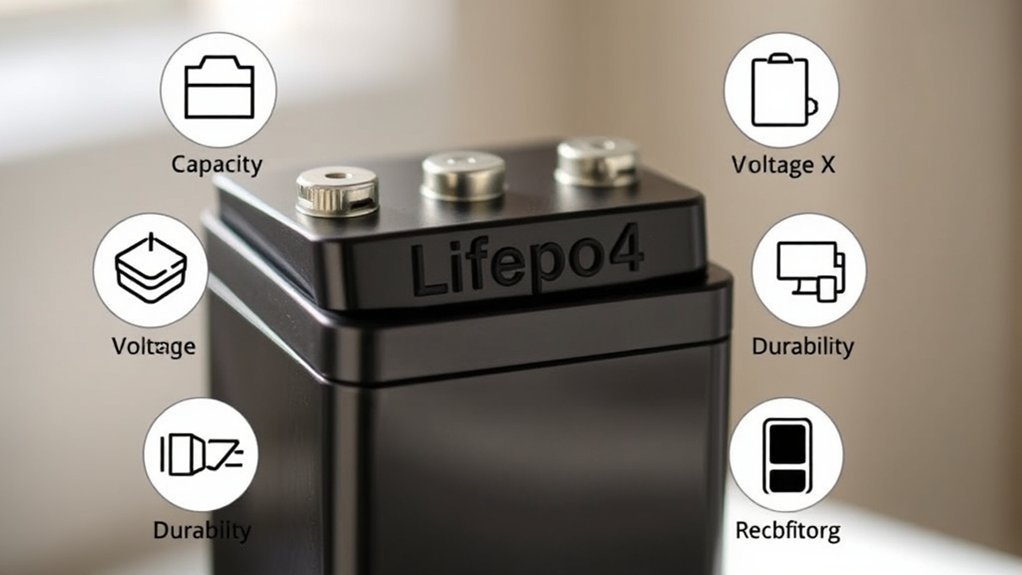
When selecting a LiFePO4 battery, understanding the key features that influence performance, safety, and lifespan is crucial for making an informed decision. Critical factors include cell chemistry stability, charge/discharge efficiency, and thermal management, which directly affect longevity and operational safety. Additionally, consider the battery’s cycle life and depth of discharge, which determine overall durability. Environmental impact is increasingly relevant, so assess the manufacturer’s commitment to sustainable practices like battery recycling, which minimizes waste and reduces ecological footprint. Safety features, such as built-in protections against overvoltage, overcurrent, and short circuits, are essential. By evaluating these features meticulously, we guarantee maximum performance while supporting environmentally responsible choices that align with long-term sustainability goals.
How to Properly Maintain and Care for Your Lifepo4 Battery
Maintaining peak performance of Lifepo4 batteries requires adherence to specific charging protocols, such as avoiding overcharging and guaranteeing consistent, controlled charging cycles. We must also prevent deep discharges, which can compromise cell integrity, and store batteries in cool, dry environments to preserve their lifespan. Proper attention to these practices ensures safety, efficiency, and prolonged battery health over time.
Regular Charging Practices
Properly maintaining a LiFePO4 battery requires adherence to specific charging protocols that optimize longevity and performance. We recommend maintaining a moderate charging speed, typically around 0.5C to 1C, to minimize thermal stress and ensure uniform cell balancing. Fast charging can accelerate capacity fade and reduce lifespan, so it’s best used sparingly. Consistent, partial charges—avoiding deep discharges—help preserve cell chemistry and extend cycle life. Proper regulation of voltage during charging, usually capped at 3.65V per cell, prevents overvoltage damage. Additionally, responsible battery recycling practices are crucial at the end of the battery’s life, reducing environmental impact. Regularly monitoring state of charge and avoiding overcharging not only enhances performance but also supports sustainable lifecycle management.
Avoid Deep Discharges
Deep discharges can drastically compromise the health of a LiFePO4 battery by causing irreversible chemical and structural changes within the cells. When a battery discharges below its recommended cut-off voltage, it risks internal degradation that reduces capacity and lifespan. Maintaining proper discharge levels helps preserve cell integrity and prolongs overall performance. Additionally, avoiding deep discharges reduces the frequency of battery recycling, which is essential for minimizing environmental impact. Deeply discharged batteries are more prone to capacity loss and potential safety hazards, emphasizing the importance of monitoring voltage levels carefully. By preventing deep discharges, we not only optimize battery longevity but also contribute to sustainable disposal practices, supporting environmentally responsible battery management and reducing the ecological footprint associated with battery manufacturing and recycling processes.
Proper Storage Conditions
To guarantee your LiFePO4 battery maintains peak performance over its lifespan, attention to storage conditions is crucial. Proper storage minimizes capacity loss and mitigates environmental impact, especially when considering battery recycling. Store batteries in a cool, dry place, ideally between 0°C and 25°C, and at a state of charge around 50%. Extended storage at high temperatures accelerates capacity fade and increases the risk of thermal runaway. Conversely, deep discharges during storage can cause capacity loss. To illustrate, here’s a quick overview:
| Storage Condition | Rationale |
|---|---|
| Temperature | Prevents thermal degradation |
| State of Charge | Maintains cell balance and longevity |
| Environment | Reduces corrosion and contamination |
Proper storage practices are essential for sustainability and efficient recycling, reducing environmental impact.
Best Applications for Lifepo4 Batteries: Solar, EVs, and Portable Devices
Lifepo4 batteries are highly suited for solar power storage due to their long cycle life, high energy density, and stable voltage output, making them ideal for renewable energy systems. They also offer excellent compatibility with electric vehicles, providing reliable, fast-charging capabilities and enhanced safety profiles. Additionally, their lightweight design and high discharge rates make them well-suited for portable electronic devices where performance and longevity are critical.
Solar Power Storage Solutions
Because of their high energy density, long cycle life, and stable performance across a wide temperature range, Lifepo4 batteries are increasingly favored for solar power storage applications. Their durability guarantees reliable energy retention over extended periods, reducing maintenance and replacement costs. From a manufacturing perspective, optimizing manufacturing processes enhances cell consistency and safety, while sustainable practices like battery recycling minimize environmental impact. Lifepo4 batteries also support modular configurations, allowing scalable energy solutions aligned with specific solar setups. Their inherent thermal stability prevents thermal runaway, making them suitable for outdoor environments. Additionally, advancements in recycling techniques recover valuable materials, promoting eco-friendly lifecycle management. These features collectively position Lifepo4 batteries as a technically superior choice for efficient, sustainable solar energy storage systems.
Electric Vehicle Compatibility
Are Lifepo4 batteries well-suited for electric vehicle applications? Absolutely, due to their high energy density, stability, and long cycle life. They support numerous charging cycles—often exceeding 2,000—making them ideal for EVs requiring durability and reliability. Their thermal stability reduces safety risks, enabling safer operation under high current loads. Additionally, Lifepo4 batteries facilitate efficient battery recycling, which is essential for sustainable EV battery management and minimizing environmental impact. Their consistent performance over many cycles maintains maximum vehicle range and power output, making them a preferred choice for electric vehicles. Overall, their combination of safety, longevity, and eco-friendliness positions Lifepo4 batteries as a superior energy storage solution for EV applications.
Comparing Lifepo4 Batteries to Lithium-Ion and AGM Batteries
How do LiFePO4 batteries truly compare to lithium-ion and AGM batteries regarding performance, safety, and longevity? LiFePO4 cells offer superior thermal stability, reducing risks like thermal runaway, unlike lithium-ion batteries prone to overheating. They excel in longevity, often surpassing 2,000 charge cycles, which minimizes replacement frequency and lowers overall environmental impact. AGM batteries, while robust and maintenance-free, have shorter cycle lives and lower efficiency. In terms of sustainability, LiFePO4 batteries facilitate better battery recycling processes due to their stable chemistry, further reducing environmental footprint. Key distinctions include:
- Safety: LiFePO4 resists thermal runaway better than lithium-ion.
- Cycle Life: LiFePO4 outlasts AGM and lithium-ion in lifespan.
- Environmental Impact: Better suited for recycling, reducing waste.
- Performance: Consistent discharge rates and minimal capacity fade over time.
Common Challenges and Troubleshooting Lifepo4 Battery Issues
While LiFePO4 batteries are renowned for their stability and durability, they can still encounter specific challenges that require careful diagnosis and troubleshooting. Over time, issues like capacity fade, internal resistance increase, or voltage imbalance may arise, often due to improper charging, aging, or manufacturing defects. Diagnosing these problems involves testing voltage levels, inspecting cell uniformity, and monitoring temperature during operation. Addressing these issues promptly can extend battery lifespan and maintain performance. Proper battery recycling is essential at end-of-life, as improper disposal impacts environmental health. Understanding these challenges emphasizes the importance of responsible handling, reducing environmental impact, and ensuring sustainable use of LiFePO4 technology. Regular maintenance and monitoring help mitigate common problems effectively.
Safety Tips for Handling and Installing Lifepo4 Batteries
Handling and installing LiFePO4 batteries safely is crucial to prevent accidents, damage, and performance issues. Proper procedures minimize risks such as short circuits, thermal runaway, and electrical shock. Always wear insulated gloves and eye protection during handling. Confirm correct polarity connections to avoid damage and monitor voltage levels to prevent overcharging. Secure batteries in well-ventilated enclosures, and avoid exposure to extreme temperatures. Responsible battery recycling reduces environmental impact and conserves resources; improper disposal can cause ecological harm. When installing, verify compatibility with existing systems and adhere to manufacturer guidelines. Regular inspections for corrosion or damage are necessary to maintain safety and longevity. Following these technical safety protocols ensures peak performance and minimizes environmental risks associated with improper disposal.
Cost and Budgeting: Are Lifepo4 Batteries Worth the Investment?
When evaluating Lifepo4 batteries, we must consider their higher upfront costs relative to traditional options, but also analyze their long-term savings through increased lifespan and efficiency. These batteries typically offer lower maintenance and replacement expenses over time, which can offset initial investments. Ultimately, examining their cost-effectiveness requires a detailed comparison of initial expenditure versus projected operational savings.
Upfront Cost Analysis
The initial investment in Lifepo4 batteries typically exceeds that of traditional lead-acid counterparts, prompting many to scrutinize their long-term value. A thorough cost comparison reveals that while upfront costs are higher, factors like lifespan, efficiency, and safety offset initial expenses. For effective budget planning, consider:
- Higher initial purchase price but longer cycle life
- Reduced maintenance costs due to superior durability
- Enhanced charge/discharge efficiency leading to energy savings
- Lower replacement frequency, decreasing long-term expenses
Although Lifepo4 batteries demand a larger upfront budget, their technical advantages—such as higher depth of discharge and safety margins—can justify the investment. Careful financial analysis ensures that the initial costs align with long-term operational goals, making them a strategic choice for sustainable energy solutions.
Long-Term Savings Potential
While the higher initial cost of Lifepo4 batteries may seem intimidating, their true value becomes evident over extended periods through substantial long-term savings. Their superior cycle life—often exceeding 2,000 charge cycles—reduces replacement frequency, lowering overall lifecycle costs. Additionally, Lifepo4 batteries have a lower environmental impact due to their stability and safer chemistry, facilitating more efficient battery recycling processes and minimizing hazardous waste. This sustainability aspect not only benefits the environment but also aligns with future regulatory trends, potentially reducing costs related to disposal and compliance. Over time, these factors translate into significant savings when compared to traditional lead-acid batteries, making Lifepo4 a financially sound investment despite the upfront expense. The combined benefits of durability, safety, and environmental responsibility underscore their long-term economic viability.
Future Trends and Innovations in Lifepo4 Battery Technology
Advancements in materials science and manufacturing processes are driving rapid innovation in LiFePO4 battery technology, promising enhanced performance, safety, and sustainability. Cutting-edge manufacturing advancements are enabling higher energy densities and improved cycle life, while also reducing production costs. Future developments focus on integrating sophisticated battery recycling techniques to minimize environmental impact and recover valuable materials efficiently. Researchers are exploring solid-state electrolytes to boost thermal stability and safety further. Additionally, innovations in electrode material engineering aim to extend lifespan and charge/discharge rates. These trends support scalable, eco-friendly solutions crucial for renewable energy storage and electric vehicles. Ultimately, ongoing improvements will make LiFePO4 batteries more durable, sustainable, and cost-effective, reinforcing their role as the future standard in energy storage systems.
Frequently Asked Questions
How Long Do Lifepo4 Batteries Typically Last?
Lifepo4 batteries typically last around 2,000 to 3,000 charging cycles, translating to 8-10 years of reliable use, depending on usage and maintenance, with proper care considerably extending their maximum battery lifespan.
Can Lifepo4 Batteries Be Recycled?
Like reborn phoenixes, LiFePO4 batteries can be recycled through specialized processes that recover valuable materials, reducing environmental impact. This recycling process minimizes waste, conserves resources, and promotes sustainable energy practices, ensuring eco-friendly battery lifecycle management.
What Temperatures Are Optimal for Lifepo4 Battery Use?
We find that Lifepo4 battery chemistry offers excellent temperature stability, operating ideally between 0°C and 45°C, ensuring consistent performance and longevity. Maintaining this temperature range prevents degradation and maximizes your battery’s safety and efficiency.
Are Lifepo4 Batteries Suitable for Extreme Weather Conditions?
Lifepo4 batteries offer excellent temperature resilience and reliable weather performance, making them suitable for extreme conditions. Their stable chemistry guarantees safe operation across diverse environments, but proper thermal management enhances longevity and overall efficiency in harsh climates.
How Do I Dispose of a Dead Lifepo4 Battery Safely?
We recommend battery recycling through certified facilities, following safety precautions like wearing protective gear and avoiding physical damage. Proper disposal prevents environmental harm and guarantees safe handling of residual chemicals, aligning with industry standards and legal requirements.
Conclusion
Together, we’ve navigated the complex landscape of LiFePO4 batteries, uncovering their robust chemistry and strategic advantages. Like a steady lighthouse guiding ships through turbulent waters, these batteries offer reliability and safety for diverse applications. As technology advances, their potential will continue to illuminate sustainable energy pathways. With proper understanding and care, we can harness this powerful energy source to build resilient, eco-friendly systems that stand the test of time and innovation.