While LiFePO4 batteries are known for their stability and longevity, neglecting proper upkeep can greatly diminish their performance and lifespan. Understanding the essential maintenance practices is critical, especially for beginners who may not be familiar with the nuances of battery care. Establishing a clear, technical approach to charging, discharging, and storage ensures safety and efficiency. To optimize your investment and avoid costly issues, it’s important to grasp these foundational principles—here’s what you need to know.
Key Takeaways
- Keep the State of Charge (SOC) between 20% and 80% for optimal battery health.
- Use compatible chargers to prevent overvoltage and overcharging.
- Store batteries in a cool, dry place with partial charge when not in use.
- Regularly monitor voltage, current, and temperature during operation.
- Recycle batteries properly at end-of-life to support sustainability.
How Do LiFePO4 Batteries Work and Why Are They Popular?
LiFePO4 batteries operate through a lithium iron phosphate cathode and a graphite anode, facilitating a stable electrochemical reaction that delivers high energy density and long cycle life. Their robust chemistry minimizes thermal runaway and enhances safety, contributing to widespread popularity. Additionally, the use of environmentally friendly materials reduces the environmental impact compared to other lithium-ion chemistries. Their longevity decreases the frequency of battery replacements, further supporting sustainable practices like battery recycling. Recycling LiFePO4 batteries is crucial to recover valuable materials and reduce waste, aligning with eco-conscious initiatives. This combination of safety, durability, and environmental consideration makes LiFePO4 batteries a preferred choice for many applications, emphasizing their role in advancing sustainable energy storage solutions with minimized ecological footprint.
Essential Tips for Proper Charging and Discharging

To guarantee maximum lifespan and ideal performance, it’s essential to follow proper charging and discharging protocols. Limiting charge cycles and adhering to discharge limits prevent premature battery degradation. For Lifepo4 batteries, maintaining a state of charge (SOC) between 20% and 80% optimizes cycle life. Avoid deep discharges below 10%, as this stresses the cells and reduces longevity. During charging, use a charger compatible with Lifepo4 chemistry to prevent overvoltage, which can damage the battery. Consistent, controlled charging prevents capacity loss and maintains efficiency. Monitoring voltage and current levels ensures adherence to safe discharge limits. Properly managing charge cycles and respecting discharge limits are key to maximizing the lifespan and performance of your Lifepo4 battery.
Maintaining Battery Health: Cleaning, Storage, and Usage Practices
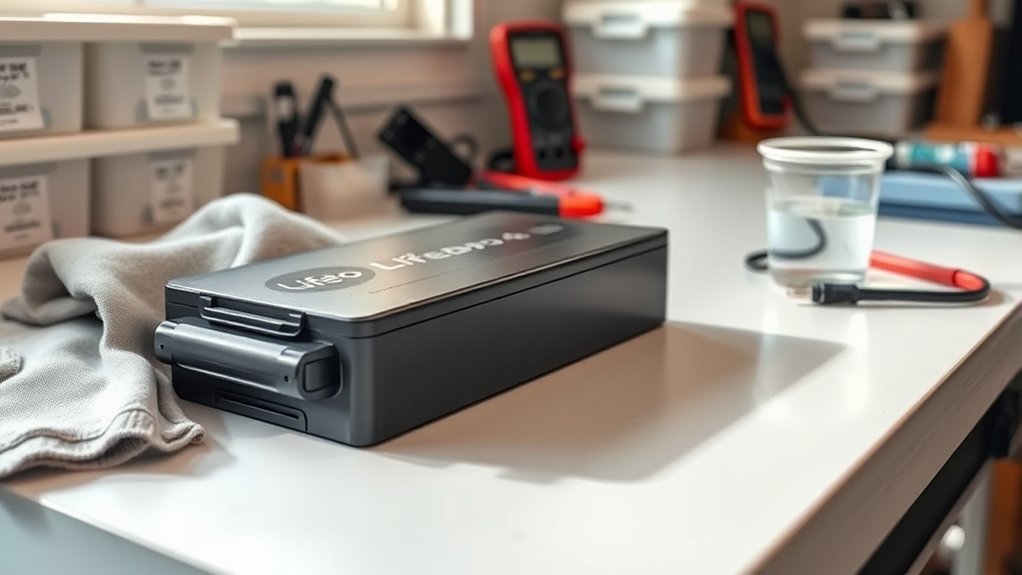
Maintaining battery health requires careful attention to cleaning, storage, and usage practices that prevent damage and preserve performance. Regular cleaning involves using a soft, non-abrasive cloth to remove dust and debris, avoiding conductive materials that could cause short circuits. Proper storage means keeping the Lifepo4 battery in a cool, dry environment, ideally at a partial state of charge, to minimize capacity loss over time. During operation, avoid deep discharges and overcharging, which can degrade cell chemistry. Responsible maintenance also considers environmental impact; proper battery recycling prevents harmful materials from entering ecosystems. Implementing these practices prolongs battery lifespan and reduces waste, contributing to sustainable energy use. Adhering to precise handling methods ensures peak performance while supporting eco-friendly disposal protocols.
Monitoring Battery Performance and Detecting Issues Early
Regularly monitoring battery performance is vital for early detection of potential issues that could compromise functionality or safety. Using precise voltage and current measurements helps identify irregularities indicative of capacity loss or cell imbalance. Monitoring temperature data is essential for effective thermal management, preventing overheating that can accelerate degradation. Consistent thermal management guarantees the battery operates within ideal temperature ranges, reducing risks of thermal runaway. Additionally, tracking capacity fade over time informs decisions on battery recycling, guaranteeing environmentally responsible disposal when performance drops below usable levels. Early detection of anomalies allows timely maintenance, avoiding costly repairs or replacements. Implementing systematic performance checks and analyzing data helps maintain battery integrity, safety, and efficiency throughout its lifespan.
Best Practices for Extending Your LiFePO4 Battery’s Lifespan
Implementing proper charging and discharging routines is essential for maximizing the lifespan of your LiFePO4 battery. Understanding the battery chemistry helps us maintain ideal voltage levels, avoiding deep discharges or overcharging that can degrade cell integrity. Maintaining a charge between 20% and 80% extends cycle life and minimizes stress on the chemistry. Regularly monitoring voltage and temperature ensures safe operation and early detection of potential issues. Additionally, adopting appropriate recycling methods at the end of the battery’s lifespan prevents environmental harm and recovers valuable materials. Proper disposal and recycling also encourage sustainable practices aligned with the battery chemistry’s recyclability. Following these best practices ensures your LiFePO4 battery remains reliable, efficient, and environmentally responsible over its service life.
Frequently Asked Questions
How Often Should I Perform Maintenance on My Lifepo4 Battery?
We recommend inspecting your Lifepo4 battery monthly, focusing on proper battery charging and ideal storage conditions; guarantee it’s stored in a cool, dry environment and avoid deep discharges, to maintain longevity and performance through routine maintenance.
Can Lifepo4 Batteries Be Used in Extreme Temperatures?
We’ve found that Lifepo4 batteries handle temperatures between -20°C and 60°C effectively, thanks to their temperature resilience. Proper battery insulation is vital in extreme conditions to prevent performance degradation and guarantee safety, especially in harsh environments.
What Are Signs of a Failing Lifepo4 Battery?
We notice failing Lifepo4 batteries when battery capacity diminishes considerably and voltage stability becomes erratic, indicating reduced performance and potential internal issues, prompting us to monitor these signs closely for timely maintenance or replacement.
Is It Safe to Leave My Lifepo4 Battery Plugged in Always?
Leaving your LiFePO4 battery plugged in constantly isn’t perfect; it can affect battery life due to continuous charging cycles and improper battery storage. We recommend disconnecting after full charge to maintain the best performance and longevity.
How Do I Dispose of or Recycle My Old Lifepo4 Battery Properly?
We recommend battery recycling through certified facilities, ensuring proper disposal methods. Investigating safe disposal confirms that recycling minimizes environmental impact, prevents hazards, and complies with regulations, making it the most responsible choice for old LiFePO4 batteries.
Conclusion
By following these straightforward maintenance practices, we can greatly extend our LiFePO4 batteries’ lifespan and guarantee their safe operation. However, the true test lies in our vigilance—regular monitoring and proactive care can prevent unexpected failures and release peak performance. Don’t underestimate the power of consistent upkeep; a small oversight today could lead to unexpected consequences tomorrow. Stay attentive, stay prepared, and realize the full potential of your battery’s longevity.