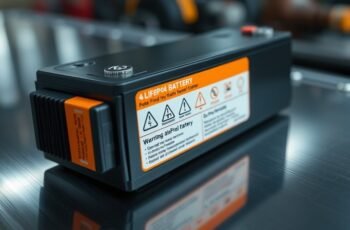
Imagine a solar energy storage system that initially performs well but quickly struggles in cold weather, prompting questions about its reliability. As we examine LiFePO4 batteries, we find that despite their safety and long cycle life, their limitations—such as reduced capacity in low temperatures and complex management needs—raise important concerns. Understanding these challenges is vital for evaluating their suitability in demanding applications, and there’s more beneath the surface that we need to take into account.
Key Takeaways
- Lower energy density limits their suitability for space-constrained applications.
- Reduced lifespan with repeated cycles increases long-term replacement costs.
- Performance declines in cold temperatures, affecting capacity and charging efficiency.
- Thermal runaway risk exists if batteries are exposed to high temperatures or damage.
- Recycling is complex and requires specialized facilities, posing environmental challenges.
What Are the Main Limitations of Lifepo4 Batteries?
Although LiFePO4 batteries are renowned for their safety and long cycle life, they do have notable limitations that can impact their suitability for certain applications. One primary concern is their relatively lower energy density compared to other lithium-ion chemistries, which can restrict their use in space-constrained settings. Additionally, their battery lifespan, while lengthy, eventually declines with repeated cycles, affecting overall longevity. Recycling considerations also pose challenges; although recyclable, the process requires specialized facilities and can generate environmental concerns if not properly managed. These limitations influence decisions around deployment, especially where maximizing energy density or ease of disposal is critical. Understanding these constraints helps us evaluate LiFePO4 batteries’ role in specific applications, balancing safety and sustainability with performance needs.
How Do Lifepo4 Batteries Perform in Extreme Temperatures?

Lifepo4 batteries demonstrate notable resilience across a range of operating conditions, but their performance can be markedly affected by extreme temperatures. Their temperature resilience is generally high within moderate ranges, maintaining stable voltage and capacity. However, in cold environments, their cold performance diminishes substantially; chemical reactions slow, reducing capacity and increasing internal resistance. This results in reduced power output and longer charging times. Conversely, high temperatures can accelerate degradation, impacting longevity and safety. While Lifepo4 chemistry offers better thermal stability than other lithium-ion variants, extreme cold still hampers efficiency. To optimize performance, thermal management is essential, especially in applications exposed to harsh climates. In sum, Lifepo4 batteries perform reliably within specified temperature ranges, but extreme cold presents notable challenges that can impair overall functionality.
Are Lifepo4 Batteries Cost-Effective Long-Term?
While Lifepo4 batteries often have higher upfront costs, their extended lifespan and reduced maintenance can lead to significant savings over time. We should consider how these factors balance against initial investment and replacement expenses. Analyzing long-term savings potential requires a precise assessment of durability, operational costs, and warranty coverage.
Initial Purchase Price
Is the higher initial cost of Lifepo4 batteries justified when considering their long-term value? While the upfront expense is notable, market availability and brand reputation considerably influence cost-effectiveness. Lifepo4 batteries tend to have a higher purchase price compared to traditional lead-acid options, primarily due to advanced chemistry and manufacturing processes. However, well-established brands with strong reputations often offer better quality assurance and more reliable performance, justifying the premium. As market availability expands, prices are gradually decreasing, making Lifepo4 batteries more accessible. Ultimately, their higher initial cost reflects durability, safety, and longevity, which can offset expenses over time. Careful evaluation of brand reputation and market options is essential to determine if the initial investment aligns with long-term value.
Long-Term Savings Potential
Over the lifespan of a battery, the potential savings from using Lifepo4 technology can be substantial. Its higher energy density allows for longer usage between charges, reducing operational costs over time. Additionally, Lifepo4 batteries benefit from efficient recycling processes, extending their overall lifecycle and decreasing disposal expenses. To quantify this, consider the following:
| Aspect | Impact | Benefit |
|---|---|---|
| Energy Density | Greater capacity per unit volume | Fewer batteries needed, lowering costs |
| Cycle Life | Up to 3,000 cycles | Reduced replacement frequency |
| Recycling Processes | Environmentally friendly, cost-effective | Easier disposal and reuse |
| Total Cost of Ownership | Lower over time due to longevity and efficiency | Long-term savings |
| Maintenance | Minimal, due to stable chemistry | Further cost reduction |
These factors collectively enhance Lifepo4’s cost-effectiveness in the long run.
Maintenance and Replacement Costs
Because Lifepo4 batteries are known for their stability and durability, they generally incur lower maintenance and replacement costs over their lifespan. Their longer cycle life reduces frequent replacements, resulting in cost savings. Additionally, lower manufacturing costs for Lifepo4 cells, owing to simpler chemistry, contribute to overall affordability. However, expenses related to battery recycling become relevant at end-of-life, impacting sustainability costs. Proper management of recycling processes can offset some economic benefits by decreasing environmental disposal costs. Despite higher initial investment, the reduced frequency of replacements and minimal maintenance requirements make Lifepo4 batteries cost-effective long-term. Key factors influencing costs include:
- Efficient battery recycling practices
- Economies of scale in manufacturing
- Lower maintenance due to chemical stability
What Are the Charging and Discharging Challenges With Lifepo4?
While LiFePO4 batteries are known for their stability and safety, they present specific challenges during charging and discharging processes that can impact performance. One key issue is charging efficiency, which can be affected by improper voltage regulation, leading to incomplete charging or overcharging risks. This reduces overall energy utilization and shortens battery lifespan. During discharge, LiFePO4 batteries typically offer a high number of discharge cycles, but their capacity can decline faster if discharged below recommended voltage levels. Additionally, their voltage profile during discharge is relatively flat, making it difficult to precisely gauge remaining capacity. These challenges necessitate sophisticated charging controllers and careful management to optimize performance, energy retention, and longevity of the battery system.
Can Lifepo4 Batteries Handle High Power Demands?
LiFePO4 batteries are generally well-suited for high power applications due to their ability to deliver rapid bursts of current without significant voltage sag. Their high power density allows them to handle demanding loads, maintaining voltage stability during peak demands. This makes them suitable for applications requiring quick acceleration or high current draws. However, their performance depends on factors like temperature and battery management systems, which influence their current delivery capacity. The inherent chemistry supports sustained high discharge rates, but exceeding recommended limits can impair longevity. Proper design ensures that these batteries efficiently meet high power demands without compromising safety or lifespan.
- Voltage stability under load fluctuations
- Power density limitations during prolonged high discharge
- Thermal management’s impact on current handling
What Safety Concerns Are Associated With Lifepo4 Batteries?
While Lifepo4 batteries are generally considered safer than other chemistries, there are still risks related to thermal runaway, which can cause rapid temperature increases and fires if not properly managed. Ensuring correct handling procedures and adherence to safety protocols is essential to mitigate these hazards. Additionally, implementing effective fire safety measures is vital to prevent and control potential emergencies.
Thermal Runaway Risks
Thermal runaway remains a critical safety concern associated with lithium iron phosphate (LiFePO4) batteries, despite their reputation for enhanced stability compared to other lithium-ion chemistries. While LiFePO4 batteries generally exhibit superior thermal stability and lower fire hazards, certain conditions can still trigger runaway reactions. Elevated temperatures, internal defects, or mechanical damage can compromise the battery’s stability, leading to uncontrollable heat buildup. This process can escalate rapidly, potentially causing fires or explosions.
Key factors influencing thermal runaway include:
- _Internal short circuits_ due to manufacturing defects or dendrite formation
- _External thermal stress_ from improper charging or environmental exposure
- _Structural damage_ that disrupts internal integrity, undermining fire hazard mitigation
Proper Handling Procedures
Proper handling of LiFePO4 batteries is essential to minimize safety risks and prevent incidents such as short circuits, thermal runaway, or mechanical damage. Safe handling preserves battery lifespan and guarantees optimal performance over numerous charging cycles. Critical procedures include avoiding punctures, keeping terminals insulated, and monitoring temperature during use. Handling errors, such as overcharging or deep discharging, can accelerate capacity loss and compromise safety.
| Handling Aspect | Best Practice |
|---|---|
| Mechanical Damage | Prevent punctures and impacts |
| Temperature Management | Keep within recommended operating range |
| Terminal Safety | Insulate terminals during storage |
| Charging Protocols | Use compatible chargers, avoid overcharging |
| Storage Conditions | Store in cool, dry environments |
Fire Safety Measures
What are the primary fire safety concerns associated with LiFePO4 batteries? Although considered safer than other chemistries, they still pose risks if mishandled. Thermal runaway can occur under extreme conditions, leading to fires or explosions. To mitigate this, implementing robust safety protocols is essential, including proper ventilation, temperature monitoring, and protective enclosures. Fire suppression systems tailored for lithium-ion fires, such as foam or dry powder extinguishers, are vital for prompt response. Additionally, ensuring correct charging practices and avoiding physical damage reduces the risk of ignition. Understanding these safety concerns guides the development of effective fire safety measures, minimizing potential hazards and ensuring safe operation of LiFePO4 batteries in various applications.
How Do Lifepo4 Batteries Impact Environmental Sustainability?
Lifepo4 (lithium iron phosphate) batteries are often regarded as a more environmentally sustainable energy storage solution due to their inherent material properties and manufacturing processes. Their use of eco friendly materials reduces reliance on scarce or toxic elements, minimizing ecological impact. Additionally, Lifepo4 batteries offer advantages in recycling initiatives; their stable chemistry facilitates safer and more efficient recycling procedures compared to other lithium-ion chemistries. This enhances the overall sustainability profile by enabling the recovery of valuable materials and reducing waste. However, while these batteries demonstrate improved environmental credentials, challenges remain in scaling recycling efforts and ensuring responsible sourcing. Overall, Lifepo4 batteries contribute positively to environmental sustainability but require continued development in recycling infrastructure and material management to maximize their eco-friendly potential.
Are There Compatibility Issues With Existing Battery Systems?
While Lifepo4 batteries are increasingly popular, compatibility issues can arise when integrating them into existing battery systems. These challenges often relate to differences in manufacturing compatibility and the overall system design. Ensuring seamless integration requires careful assessment of voltage compatibility, charge/discharge profiles, and thermal management. Particularly, discrepancies in battery lifespan expectations may lead to uneven wear or premature failure when combined with older systems. Additionally, mismatched cell configurations can cause operational inefficiencies.
- Voltage and current compatibility across different systems
- Variations in manufacturing standards affecting performance
- Potential need for system recalibration to optimize lifespan and efficiency
What Are Common Troubleshooting and Maintenance Challenges?
Integrating Lifepo4 batteries into existing systems often presents practical challenges related to troubleshooting and ongoing maintenance. One primary issue is battery degradation over time, which affects overall performance and capacity, requiring vigilant monitoring. Ensuring voltage stability can also be complex, especially under variable load conditions, as fluctuations may indicate underlying problems or aging cells. Troubleshooting often involves identifying subtle signs of imbalance or internal faults before they escalate, demanding specialized tools and expertise. Maintenance challenges include balancing cells to prevent uneven degradation and managing temperature to avoid capacity loss. Addressing these issues proactively is essential for maintaining ideal lifespan and safety. Proper understanding of battery behavior under different conditions helps mitigate these common challenges, ensuring reliable system operation.
Frequently Asked Questions
How Do Lifepo4 Batteries Compare to Other Lithium-Ion Batteries?
We find Lifepo4 batteries safer due to superior battery safety features and thermal stability; although their initial cost is higher, they offer better long-term value through extended cycle life compared to other lithium-ion batteries.
What Is the Typical Lifespan of a Lifepo4 Battery?
We find that Lifepo4 batteries typically last 2,000 to 5,000 charging cycles before significant battery degradation occurs, translating to around 8-10 years of reliable use, highlighting their impressive longevity despite frequent cycling.
Can Lifepo4 Batteries Be Recycled Easily?
We believe Lifepo4 batteries can be recycled, but recycling challenges exist due to complex materials and safety concerns. This impacts their environmental footprint, requiring advanced processes to minimize environmental impact and improve recycling efficiency.
How Do Temperature Fluctuations Affect Lifepo4 Battery Performance?
Temperature fluctuations challenge Lifepo4 batteries’ thermal stability and temperature resilience, ironically causing performance dips. Rapid changes increase internal stress, reducing lifespan and efficiency, highlighting the importance of maintaining stable temperatures for ideal, long-term battery performance.
Are Lifepo4 Batteries Suitable for Portable Electronic Devices?
We believe LiFePO4 batteries are suitable for portable electronics, thanks to their lightweight design and fast charging speed, which enhance device portability and efficiency. Their stable chemistry guarantees longevity and safety during frequent, rapid charge cycles.
Conclusion
Just like steering through a complex maze, understanding LiFePO4 battery limitations helps us choose the right path for our energy needs. While they offer safety and longevity, their constraints—temperature sensitivity, lower energy density, and management complexity—remind us that no solution is perfect. By carefully weighing these factors, we can chart a more informed course, ensuring our energy systems remain efficient, safe, and sustainable—guiding us through the intricate maze toward peak performance.