We compare Lifepo4 and Li-Ion batteries based on chemistry, safety, weight, longevity, and cost. We analyze their strengths and weaknesses, considering practical applications and performance factors. We examine how each battery type aligns with specific needs, from safety-critical systems to portable devices. Understanding these differences is essential for making informed choices. But the question remains: which battery best suits your priorities and constraints?
Key Takeaways
- Lifepo4 offers superior safety, thermal stability, and longer cycle life compared to traditional Li-Ion batteries.
- Li-Ion batteries provide higher energy density, making them lighter and more suitable for portable devices.
- Lifepo4 is more environmentally friendly and easier to recycle due to its stable chemical composition.
- Li-Ion batteries support faster charging and are generally more cost-effective upfront.
- Lifepo4’s durability and safety make it ideal for stationary applications like electric vehicles and backup power.
How Do LiFePO4 and Li-Ion Batteries Differ in Chemistry?
Although both LiFePO4 and Li-Ion batteries rely on lithium-ion chemistry, their core differences stem from their cathode materials, which considerably impact electrochemical behavior. LiFePO4 employs lithium iron phosphate, offering a stable crystal structure that enhances thermal stability and cycle life. In contrast, typical Li-Ion batteries use cathodes like lithium cobalt oxide, which provide higher energy density but are more sensitive to thermal stress. During battery manufacturing, the choice of cathode influences electrode design and quality control processes. Recycling these batteries also varies; LiFePO4’s phosphate composition simplifies material recovery and reduces environmental impact. Overall, understanding these chemical distinctions helps optimize manufacturing techniques and recycling processes, ensuring better performance, safety, and sustainability for each battery type.
What Are the Safety Advantages of LiFePO4 Batteries?
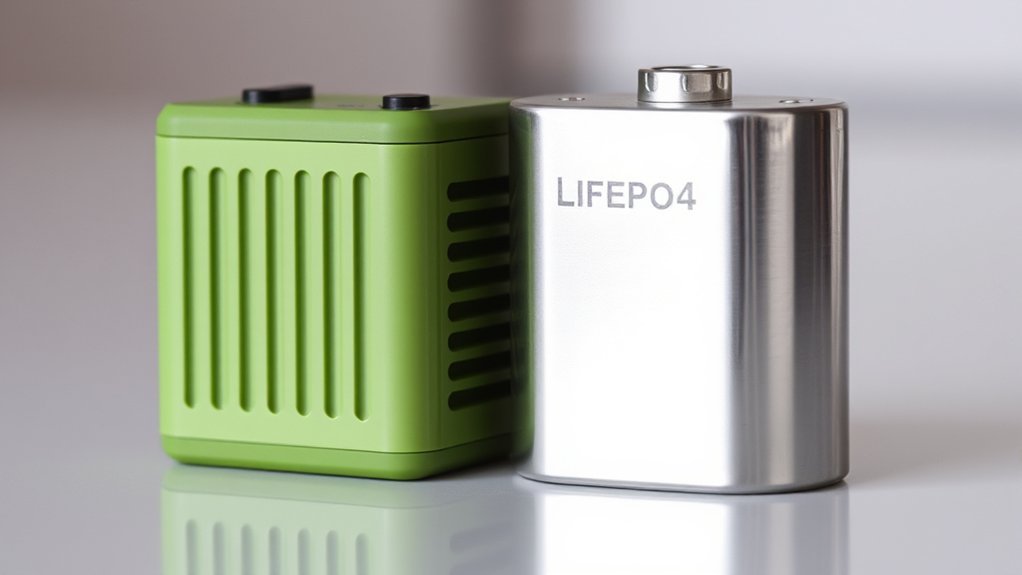
LiFePO4 batteries offer notable safety advantages due to their superior thermal stability, reducing the likelihood of overheating during operation. This stability considerably lowers the fire risk compared to other lithium-ion chemistries, making them a safer choice for many applications. Understanding these benefits helps us evaluate their overall safety profile more accurately.
Thermal Stability Benefits
Thermal stability is a critical factor that enhances the safety profile of LiFePO4 batteries, especially under high-stress conditions. Their inherent chemical structure provides superior thermal management, minimizing the risk of thermal runaway and overheating. Unlike other lithium-ion chemistries, LiFePO4’s stable phase change reduces the likelihood of catastrophic failures, making them inherently safer. This stability also facilitates safer battery recycling, as lower operating temperatures diminish degradation and hazardous byproducts. Additionally, the improved thermal stability simplifies system design, reducing the need for complex cooling solutions and further enhancing safety. Overall, LiFePO4’s strong resistance to temperature fluctuations and thermal events makes them a reliable choice for applications demanding rigorous safety standards and effective thermal management.
Reduced Fire Risk
The inherent chemical stability of LiFePO4 batteries considerably reduces the risk of fire compared to other lithium-ion chemistries. This stability enhances fire prevention by minimizing the likelihood of thermal runaway, a primary cause of battery fires. The robust chemical structure of LiFePO4 prevents rapid decomposition under fault conditions, unlike cobalt-based cathodes that can become volatile. This intrinsic safety margin makes LiFePO4 batteries less prone to overheating and combustion. Their chemical stability ensures a safer operating profile, especially under stress or damage. As a result, these batteries are favored in applications where safety is paramount, providing peace of mind and reducing the need for complex fire suppression systems. Overall, the reduced fire risk of LiFePO4 underscores its superior safety advantages.
How Do Energy Density and Weight Compare Between the Two?
While energy density and weight are critical factors in evaluating battery performance, they differ considerably between lithium iron phosphate (LiFePO4) and traditional lithium-ion (Li-ion) batteries. Regarding energy comparison, Li-ion batteries typically offer higher energy density, enabling them to store more power per unit volume or weight. This results in lighter, more compact designs suitable for applications requiring maximized energy. Conversely, LiFePO4 batteries usually have lower energy density, leading to increased weight for similar capacity. Weight considerations become significant in portable or space-constrained applications, where the added weight of LiFePO4 can be a disadvantage. Thus, when comparing these batteries, understanding the trade-off between higher energy density and weight is essential for selecting the most suitable technology for specific performance needs.
Which Battery Type Offers Better Longevity and Cycle Life?
Lifepo4 batteries generally demonstrate superior durability and cycle life due to their stable chemistry, often exceeding 2000 charge cycles with minimal capacity loss. In contrast, Li-Ion batteries typically offer fewer cycles, around 500-1000, with more noticeable capacity degradation over time. Analyzing these differences helps determine which battery type provides more reliable long-term performance for various applications.
Lifepo4 Durability Advantages
Because of their chemical stability and robust design, Lifepo4 batteries generally outperform Li-ion counterparts in longevity and cycle life. Their stable chemistry reduces degradation over repeated cycles, resulting in a higher cycle count before capacity diminishes considerably. Additionally, Lifepo4’s manufacturing processes emphasize thermal stability and safety, which contribute to longer operational lifespans. This durability simplifies battery recycling, as Lifepo4 cells maintain structural integrity over extended use, reducing hazardous waste. In contrast, Li-ion batteries often suffer from mechanical stress and capacity fade, necessitating more frequent replacements. Overall, Lifepo4’s inherent chemical stability and manufacturing advantages translate into superior durability, making them a more reliable choice for applications demanding long-term performance.
Li-Ion Cycle Stability
Li-ion batteries generally demonstrate superior cycle stability compared to Lifepo4 batteries, primarily due to their advanced electrode chemistry and optimized electrolyte formulations. This results in higher cycle counts before capacity fade, making them suitable for applications demanding longevity. Their manufacturing processes incorporate precise control over electrode materials, reducing degradation over repeated charge-discharge cycles. Additionally, improved battery recycling techniques help recover valuable materials, extending overall lifecycle sustainability. In contrast, Lifepo4 batteries tend to have slightly lower cycle life but offer consistent performance and enhanced thermal stability. Ultimately, Li-ion’s enhanced cycle stability stems from their refined chemistry and manufacturing innovations, providing better longevity for high-demand applications while also considering environmental impacts through improved battery recycling methods.
How Do Costs and Maintenance Requirements Stack Up?
When evaluating the long-term financial implications of battery choices, it becomes clear that Lifepo4 batteries generally incur higher initial costs but offer lower maintenance expenses over their lifespan compared to Li-ion batteries. A thorough cost analysis reveals that Lifepo4’s robust chemistry reduces the frequency and complexity of maintenance routines, such as electrolyte checks or coolant replacements required for Li-ion variants. These batteries are inherently more stable, decreasing the likelihood of performance degradation and costly replacements. While the upfront investment is steeper, the lower maintenance demands translate into savings over time, making Lifepo4 a more economical option for long-term applications. Conversely, Li-ion batteries, with their comparatively lower initial price, demand more frequent vigilance and upkeep, which can offset their initial affordability.
For Which Applications Is LiFePO4 the Best Choice?
Have we considered which applications benefit most from the unique properties of LiFePO4 batteries? Their stability, safety, and long cycle life make them ideal for specific uses.
- Renewable energy storage: LiFePO4’s thermal stability supports large-scale solar or wind energy systems, reducing risks during battery recycling and simplifying manufacturing processes.
- Electric vehicles: Their high cycle life and safety profile are critical, especially in applications requiring frequent charge-discharge cycles, with manufacturing emphasizing sustainable practices.
- Backup power systems: Reliable performance and minimal thermal management needs make LiFePO4 suitable for UPS and telecom backup units, where safety and recyclability are priorities. These factors ensure optimal application fit while supporting environmentally conscious manufacturing.
When Should You Opt for a Traditional Li-Ion Battery?
While LiFePO4 batteries excel in applications demanding stability and long cycle life, there are scenarios where traditional Li-Ion batteries are preferable. When higher energy density is critical—for instance, in portable electronics or electric vehicles—Li-Ion batteries provide a significant advantage due to their compactness. Additionally, if considerations around battery recycling and environmental impact are prioritized, Li-Ion systems can be more manageable, as established recycling protocols exist for these chemistries. Their widespread adoption facilitates more efficient recycling processes, reducing ecological footprint over multiple cycles. Moreover, in applications requiring rapid charging and discharging, Li-Ion batteries often outperform LiFePO4, making them the most suitable choice when performance demands outweigh lifespan concerns. Ultimately, selecting Li-Ion hinges on balancing energy needs, environmental factors, and end-of-life management.
What Are the Key Factors to Consider When Choosing Between Them?
Selecting the appropriate battery type requires a careful analysis of multiple technical and practical factors to guarantee peak performance and longevity. Key considerations include:
- Environmental impact and Battery recycling: Lifepo4 batteries offer a more sustainable profile with easier recycling processes, reducing ecological footprints compared to Li-ion.
- Performance specifications: Evaluate capacity, cycle life, and thermal stability; Lifepo4 generally provides longer lifespan and better thermal resilience.
- Cost and availability: While initial costs may favor Li-ion, Lifepo4’s durability and recyclability can lower total ownership costs over time.
Understanding these factors helps balance technical performance with environmental responsibility, ensuring an informed choice that aligns with sustainability goals and operational needs.
How Can You Maximize Battery Performance and Safety in Your Setup?
Maximizing battery performance and safety in your setup requires a systematic approach to proper installation, monitoring, and maintenance. Implementing appropriate charging techniques is critical; avoiding overcharging and using compatible chargers extends battery lifespan and prevents hazards. Regular monitoring of voltage, temperature, and capacity helps identify early signs of degradation or safety issues. Additionally, adopting proper battery recycling practices ensures environmentally responsible disposal and maintains system integrity. Ensuring secure connections and correct placement reduces risks of shorts or thermal runaway. For Lifepo4 and Li-ion batteries, following manufacturer guidelines on charge cycles and storage conditions further optimizes performance. By integrating these strategies, you enhance safety, prolong battery life, and maintain reliable operation in your setup.
Frequently Asked Questions
Are Lifepo4 Batteries Environmentally Friendly Compared to Li-Ion?
We believe LiFePO4 batteries are more environmentally friendly due to their longer lifespan and safer chemistry, reducing waste and hazardous materials. Although they have lower energy density, their eco-friendly benefits outweigh the trade-offs.
How Do Charging Times Compare Between Lifepo4 and Li-Ion?
Charging times between Lifepo4 and Li-ion batteries are like a race—Lifepo4 generally charges faster, thanks to superior charging efficiency, providing steady power delivery. This makes Lifepo4 ideal for quick, reliable energy replenishment in critical applications.
Can Lifepo4 Batteries Handle High-Temperature Environments Better?
We find that Lifepo4 batteries exhibit superior thermal stability and heat resistance, making them better suited for high-temperature environments. Their robust chemical structure minimizes risks related to thermal runaway, ensuring safer operation under heat stress.
What Are the Recycling Options for Lifepo4 Versus Li-Ion Batteries?
We find that roughly 95% of Li-ion batteries are recyclable through specialized programs, whereas LiFePO4 batteries are less common but still recyclable via specific battery disposal and recycling programs, emphasizing the importance of proper disposal for sustainability.
How Do the Warranty Periods Typically Differ Between These Battery Types?
Typically, Lifepo4 batteries offer longer warranty durations, often around 8-10 years, due to their stability, while Li-ion batteries usually come with 2-5 years, influenced by manufacturer policies emphasizing longevity and safety standards.
Conclusion
Ultimately, choosing between LiFePO4 and Li-Ion batteries depends on your specific needs and priorities. Are you willing to guarantee on weight and energy density for enhanced safety, longevity, and environmental benefits? By carefully analyzing your application’s demands—whether it’s durability, space constraints, or cost—you can make an informed decision. Both options have their merits, but understanding these nuances ensures you select the most reliable, efficient power source for your goals.