Like two sides of the same coin, Lifepo4 and lithium-ion batteries each present unique charging protocols that markedly influence their performance and safety. Understanding these differences is vital for optimizing application-specific use, yet the nuances can be complex. As we explore the key aspects of their charging processes, safety considerations, and lifespan impacts, you’ll see why selecting the right method is more than just a technical choice—it’s essential for reliability and longevity.
Key Takeaways
- Lifepo4 batteries have a lower maximum voltage per cell (3.65V) compared to lithium-ion (around 4.2V), requiring different charging protocols.
- Lifepo4 supports stable, slower charging with high cycle life, while lithium-ion can accept faster charging with advanced fast-charging technologies.
- Temperature management is more critical for Lifepo4 due to higher sensitivity, impacting safety and performance during charging.
- Lifepo4 batteries are inherently safer with lower fire risk and thermal stability, influencing charging safety considerations.
- Proper CC/CV charging protocols extend lifespan for both chemistries, but Lifepo4’s stable chemistry allows for more conservative, long-term charging practices.
How Do Lifepo4 and Lithium-Ion Batteries Charge Differently?
Although both LiFePO4 and lithium-ion batteries utilize similar principles of electrochemical energy storage, their charging processes differ markedly due to their distinct chemical compositions and voltage characteristics. LiFePO4 batteries maintain a stable voltage during charging, which reduces stress on internal components and extends lifespan. Conversely, lithium-ion batteries experience voltage fluctuations that can accelerate degradation if not carefully managed. These differences influence battery recycling efforts and environmental impact; LiFePO4’s stable chemistry simplifies recycling processes and minimizes hazardous waste. Properly understanding these charging distinctions aids in optimizing lifecycle management and reducing ecological footprints. Ultimately, the unique charging behaviors impact not only performance but also the sustainability of battery use, emphasizing the importance of considering these factors in environmental impact assessments and recycling strategies.
The Charging Process of Lifepo4 Batteries: Key Characteristics
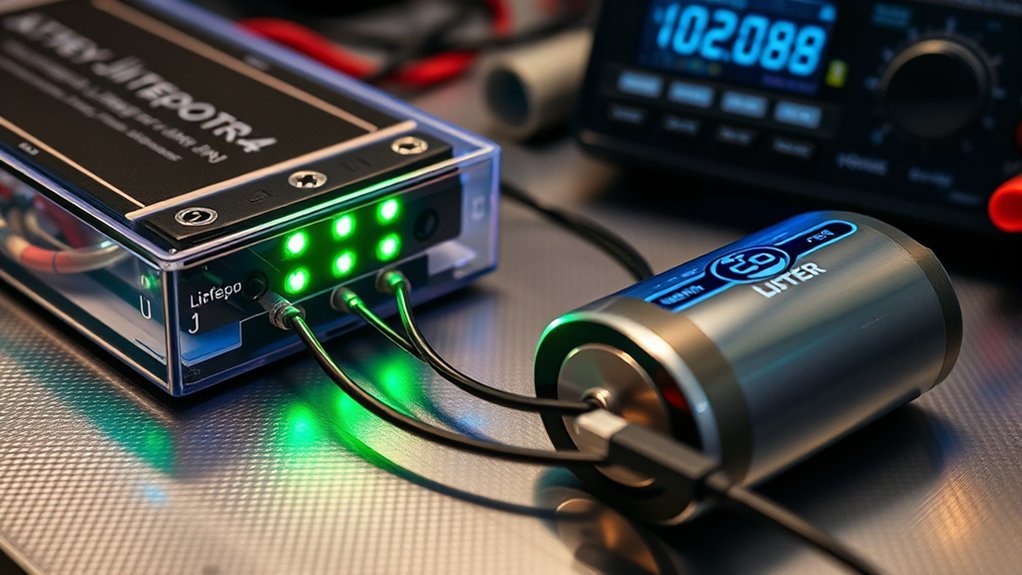
Lifepo4 batteries operate within specific charging voltage limits to guarantee safety and longevity, typically around 3.65 to 3.70 volts per cell. They exhibit stable charging rates but are sensitive to temperature fluctuations, which can affect performance and lifespan. Understanding these key characteristics allows for ideal charging strategies tailored to Lifepo4 technology.
Charging Voltage Limits
The charging voltage limits are critical parameters that directly influence the safety, performance, and lifespan of Lifepo4 batteries. Proper voltage regulation ensures the battery remains within safe operational boundaries, preventing overvoltage damage. Charging algorithms are designed around these limits, optimizing efficiency and longevity. Lifepo4 cells typically have a maximum voltage of 3.65V per cell, with a recommended charge cutoff at 14.6V for a 4-cell pack. Adhering to these limits avoids electrolyte degradation and capacity loss. The table below summarizes key voltage parameters:
| Parameter | Limit |
|---|---|
| Max Voltage per Cell | 3.65V |
| Recommended Charge Cutoff | 14.6V (for 4 cells) |
| Overvoltage Threshold | 3.65V per cell |
Maintaining these thresholds is essential for safe, efficient charging.
Charging Rate Stability
Charging rate stability is a critical aspect of the Lifepo4 battery charging process, as it directly impacts efficiency, thermal management, and overall battery longevity. Stable charging rates ensure consistent delivery of current, preserving battery capacity over multiple cycles. Lifepo4 batteries exhibit a high degree of charging rate consistency, allowing for relatively rapid charging without sacrificing charging efficiency or risking capacity fade. This consistency minimizes fluctuations that could cause uneven aging or thermal stress, maintaining the integrity of the battery’s chemistry. Precise control of the charging rate ensures maximum utilization of battery capacity while reducing energy loss during transfer. Consequently, Lifepo4’s reliable charging rate stability contributes to sustained performance, efficient energy transfer, and prolonged lifespan, making it a preferred choice for applications demanding consistent and safe charging.
Temperature Sensitivity
Because temperature exerts a significant influence on battery chemistry, understanding its impact during the charging process is essential for maximizing Lifepo4 performance. Lifepo4 batteries are highly sensitive to temperature fluctuations, which affect thermal regulation and, consequently, charging efficiency. Elevated temperatures accelerate electrochemical reactions, increasing the risk of thermal runaway, while low temperatures hinder ion mobility, reducing charging efficiency. Proper thermal regulation systems are critical to maintain ideal operating temperatures, ensuring safe and efficient charging. Maintaining stable temperatures minimizes capacity loss and prolongs lifespan. Unlike some lithium-ion chemistries, Lifepo4’s temperature sensitivity requires monitoring and control to maximize performance and safety during charging. Effective thermal management directly correlates with improved charging efficiency and overall battery health.
Lithium-Ion Battery Charging: What Sets It Apart?
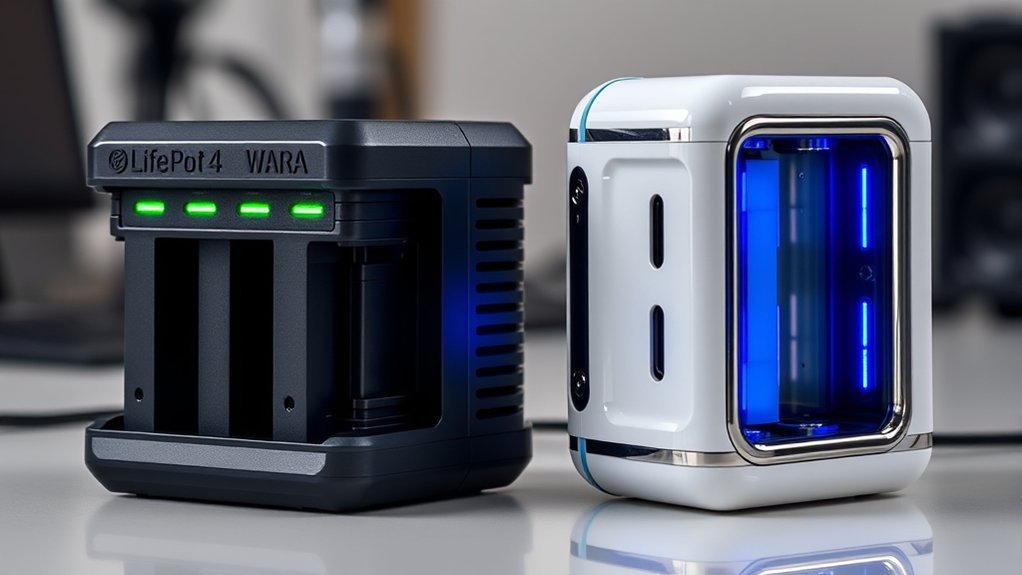
Lithium-ion batteries typically charge faster than Lifepo4 cells due to different chemistry and design. They require precise voltage control, often around 4.2V per cell, to prevent damage and guarantee longevity. Additionally, advanced battery management systems are essential to optimize performance and safety during charging.
Charging Speed Differences
While lithium-ion batteries are known for their efficiency, their charging speed varies considerably depending on system design and internal chemistry. Modern fast charging technology enables rapid energy transfer, *substantially* reducing charge times. Wireless charging, although convenient, often limits charging speed due to lower power transfer rates compared to wired methods. Advances in fast charging protocols have optimized current flow, but internal chemistry and thermal management remain critical factors affecting speed. Lithium-ion systems can typically accept higher current rates, enabling quicker charges, whereas Lifepo4 batteries generally require more conservative charging rates. Consequently, the charging speed of lithium-ion batteries can be *particularly* faster when utilizing advanced fast charging systems, but the actual rate is constrained by the battery’s chemistry and thermal considerations.
Optimal Voltage Levels
What precisely defines the most suitable voltage level during lithium-ion battery charging? It hinges on optimizing battery chemistry to maximize energy density while minimizing degradation. Charging too high risks overvoltage, damaging the electrodes, whereas too low underutilizes potential. Typically, the ideal voltage range is around 4.2V per cell, balancing capacity and longevity. The table below illustrates key parameters:
| Parameter | Typical Range | Impact |
|---|---|---|
| Voltage Level | 4.2V per cell | Maximizes energy density, limits lifespan |
| Charge Current | 0.5C-1C | Ensures safe, efficient charging |
| State of Charge (SoC) | 0-100% | Defines capacity utilization |
Maintaining precise voltage levels is essential for guaranteeing peak performance and longevity of lithium-ion batteries.
Battery Management Systems
Battery Management Systems (BMS) are critical components that actively monitor and control the charging process to guarantee safety, performance, and longevity of lithium-ion batteries. They analyze parameters such as voltage, current, and temperature in relation to specific battery chemistry to prevent overcharging, deep discharging, and thermal runaway. BMS implement sophisticated charging protocols tailored to the chemistry, ensuring ideal voltage levels and balanced cell conditions. These protocols adapt dynamically during charging, maintaining safe operation and extending battery life. Precise control of charging parameters minimizes degradation and maximizes capacity retention. Essentially, BMS serve as the regulatory backbone, integrating real-time data with intelligent algorithms to enhance charging strategies for diverse lithium-ion chemistries, thereby ensuring safe, efficient, and durable battery performance.
Safety Considerations When Charging Lifepo4 vs. Lithium-Ion Batteries
Charging Lifepo4 and lithium-ion batteries requires careful attention to safety protocols, as each chemistry presents distinct risks and considerations. Overcharging or improper handling can lead to thermal runaway, fire, or environmental hazards. Lifepo4 cells are inherently safer due to stable chemistry, but still require appropriate chargers and ventilation. Lithium-ion batteries are more sensitive, necessitating rigorous control systems to prevent overvoltage and overheating. Proper procedures reduce safety risks, support effective battery recycling, and minimize environmental impact. Consider the following safety factors:
| Safety Aspect | Lithium-Ion Batteries | Lifepo4 Batteries |
|---|---|---|
| Thermal Stability | Lower | Higher |
| Risk of Fire | Higher | Lower |
| Charging Control | Strict | Moderate |
| Ventilation Needs | Critical | Less critical |
| Environmental Impact | Higher (hazardous waste) | Lower (safer disposal) |
Lifepo4 Battery Lifespan and How Charging Impacts Durability
Understanding how charging practices influence the longevity of Lifepo4 batteries is key to maximizing their durability. Proper charging protocols, such as avoiding overcharging and maintaining ideal voltage levels, markedly extend battery lifespan. Lifepo4 batteries typically endure more charge cycles than traditional lithium-ion types, which enhances their durability. Regularly monitoring charge levels minimizes capacity loss over time, reducing the need for premature replacements. This directly impacts battery recycling efforts by decreasing electronic waste and mitigating environmental impact. Additionally, consistent, correct charging preserves battery integrity, ensuring safer operation and less hazardous degradation. By extending lifespan through disciplined charging, we contribute to more sustainable energy storage solutions, maximizing resource utilization and reducing environmental footprint.
Troubleshooting Common Charging Issues for Both Battery Types
When troubleshooting common charging issues in Lifepo4 and lithium-ion batteries, it’s essential to identify the underlying causes quickly to prevent further damage. Typical problems include overcharging, undercharging, or inconsistent voltage levels, which can impair performance and reduce lifespan. Accurate diagnosis involves checking charger compatibility, temperature conditions, and voltage regulation.
| Issue | Potential Cause |
|---|---|
| Overcharging | Faulty charger, voltage spike |
| Undercharging | Charger disconnects early |
| Voltage imbalance | Cell imbalance, aging |
| Excess heat | High ambient temperature |
| Slow charging | Battery recycling inefficiency |
Addressing these issues promptly helps mitigate environmental impact and guarantees proper battery recycling, extending lifespan and maintaining ideal operation.
Which Battery Charging Method Is Best for Your Application?
Selecting the most appropriate battery charging method depends on your specific application requirements, including safety, efficiency, and longevity. For Lifepo4 and lithium-ion batteries, optimized charging protocols—such as CC/CV (constant current/constant voltage)—maximize lifespan and performance. Proper charging also supports sustainable practices like battery recycling, reducing environmental impact. Establishing robust charging infrastructure guarantees consistent power delivery and prevents overcharging or thermal runaway. When choosing a method, consider the battery’s chemistry, cycle life, and safety features. For applications demanding rapid charging, specialized protocols that balance speed and battery health are essential. Ultimately, selecting the right charging approach enhances efficiency, extends battery life, and aligns with safety standards and environmental responsibilities.
Frequently Asked Questions
Can Lifepo4 Batteries Be Fast-Charged Without Damage?
Yes, Lifepo4 batteries can be fast-charged safely without damage when using proper chargers designed for their chemistry, ensuring ideal charging safety and preserving battery lifespan by preventing overheating and over-voltage conditions.
How Does Temperature Affect Charging Efficiency in Both Batteries?
Temperature impacts charging efficiency through thermal stability and heat dissipation; ideal temperatures guarantee safe, efficient charging, while excessive heat hampers performance and lifespan, particularly in lithium-ion batteries, but Lifepo4’s superior thermal stability offers better resilience.
Are There Specific Chargers Recommended for Lifepo4 Versus Lithium-Ion?
We recommend chargers with specific charging protocols tailored for each battery type, ensuring battery compatibility. Using specialized chargers optimizes efficiency and safety, preventing damage and prolonging lifespan for Lifepo4 and lithium-ion batteries.
What Are the Environmental Impacts of Charging Each Battery Type?
We find that Lithium-ion batteries pose greater environmental risks due to toxic materials, requiring careful battery recycling, whereas Lifepo4 batteries contain fewer toxic substances and are more environmentally friendly during charging and disposal processes.
Do Charging Habits Influence the Long-Term Health of Lifepo4 Batteries?
Charging habits dramatically impact Lifepo4 battery longevity; strict adherence to proper charging protocols prevents premature degradation. Overcharging or frequent deep discharges can considerably diminish performance, emphasizing the importance of precise, consistent charging practices for ideal long-term health.
Conclusion
In the end, choosing between Lifepo4 and lithium-ion batteries isn’t just about speed or safety—it’s about understanding their quirks. Ironically, the safer Lifepo4 batteries demand more patience, while the faster lithium-ion packs require stricter controls. Knowing these nuances helps us optimize performance and longevity, but it’s clear that neither option is perfect. Sometimes, the best choice is simply understanding the trade-offs—because in the world of batteries, every advantage comes with a hidden cost.