As the saying goes, “A chain is only as strong as its weakest link,” and in the case of LiFePO4 batteries, poor storage practices can considerably undermine their performance and lifespan. Understanding the precise requirements for safe and effective storage is essential for maximizing longevity and ensuring safety. With the right environment and handling, we can mitigate risks and maintain ideal battery health—yet, many overlook these critical details, making it crucial to explore the key principles behind proper storage.
Key Takeaways
- Store LiFePO4 batteries in a cool, dry, ventilated environment between 0°C and 25°C with stable conditions.
- Maintain a state of charge between 30% and 50% for long-term storage.
- Regularly check voltage and physical condition every 3-4 months during storage.
- Mount batteries securely in a protected, vibration-free area away from heat sources.
- Follow safe handling, transportation, and end-of-life disposal practices to ensure safety and battery longevity.
Why Proper Storage Matters for LiFePO4 Batteries
Proper storage of LiFePO4 batteries is essential to maintain their performance, longevity, and safety. Understanding battery chemistry reveals that LiFePO4 cells are more stable than other lithium-ion chemistries, but they still require careful handling to prevent degradation. Using appropriate storage containers guarantees protection from environmental factors such as moisture, temperature fluctuations, and physical damage, which can adversely affect the battery’s chemical stability. Proper containers minimize the risk of internal short circuits or chemical breakdowns by maintaining a controlled environment. Additionally, suitable storage practices prevent capacity loss and potential safety hazards. By combining insights into battery chemistry with secure, well-designed storage containers, we ensure that LiFePO4 batteries retain their best function during periods of inactivity.
Understanding the Optimal State of Charge for Storage
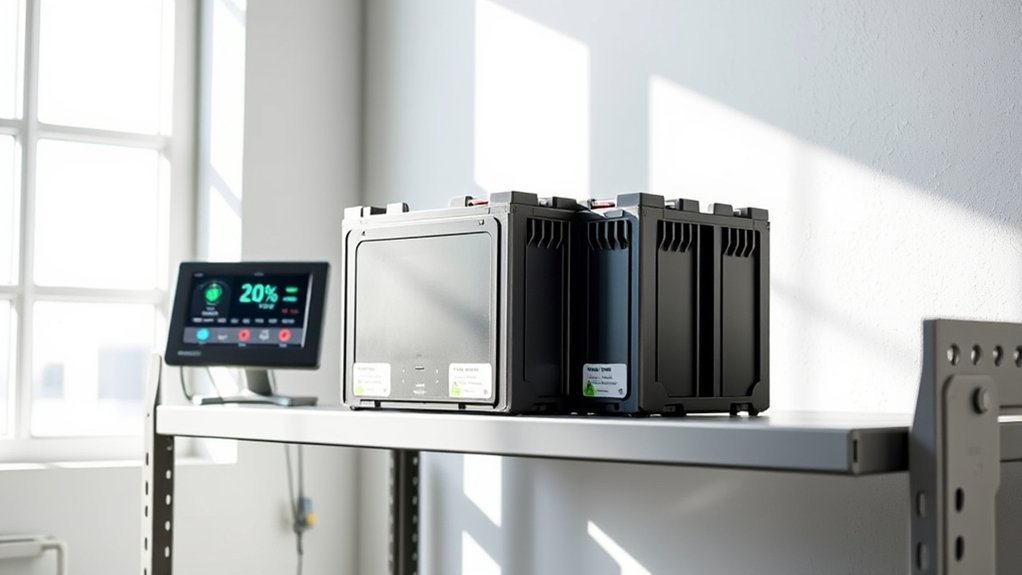
Understanding the ideal state of charge (SoC) for storage is essential to maximizing the lifespan and performance of LiFePO4 batteries. Battery chemistry dictates that keeping the SoC within a specific range minimizes capacity fade over extended storage durations. Typically, maintaining a SoC between 30% and 50% reduces stress on the cells and prevents degradation.
| Storage Duration | Recommended SoC Range | Rationale | Impact on Battery Life |
|---|---|---|---|
| Short-term | 40-50% | Minimizes self-discharge | Preserves capacity |
| Long-term | 30-50% | Limits electrolyte decomposition | Extends cycle life |
| Extended storage | 30-40% | Reduces voltage stress | Maintains efficiency |
| Frequent cycling | 40-50% | Balances charge cycles | Optimizes longevity |
Choosing the Right Storage Environment: Temperature & Humidity

Maintaining an ideal temperature range, typically between 0°C and 25°C, is critical for preserving Lifepo4 battery performance and longevity. Humidity control prevents moisture-related degradation, which can lead to capacity loss and safety issues. Environmental fluctuations outside these parameters can accelerate chemical aging, underscoring the need for stable storage conditions.
Optimal Temperature Range
Selecting the appropriate temperature range is critical to guaranteeing the longevity and performance of Lifepo4 batteries. Maintaining temperature stability minimizes thermal stress, which can accelerate capacity loss and degrade internal components. The ideal storage temperature typically falls between 0°C and 25°C, where chemical stability is maximized. Deviations outside this range can lead to increased self-discharge rates and reduced cycle life. Humidity levels also influence battery integrity; excessive moisture can cause corrosion and compromise electrical connections. Consequently, a controlled environment with stable temperatures and moderate humidity levels is essential. Precise temperature regulation not only preserves capacity but also ensures consistent performance over time, making it a fundamental aspect of effective Lifepo4 battery storage strategies.
Humidity Control Importance
Why is humidity control just as essential as temperature regulation when storing Lifepo4 batteries? Humidity effects can greatly impact battery integrity, as excess moisture promotes corrosion of internal components and deteriorates the electrolyte. Maintaining ideal humidity levels within the storage container minimizes these risks, preventing condensation that could lead to short circuits or capacity loss. Precise environmental control ensures that moisture does not accumulate, preserving battery lifespan and performance. A stable, low-humidity environment reduces the likelihood of chemical reactions triggered by moisture ingress. Consequently, selecting a proper storage container with humidity regulation features is critical to safeguarding Lifepo4 batteries, ensuring their reliability and longevity over time. Proper humidity management is a fundamental aspect of effective battery storage strategies.
Environmental Fluctuation Effects
How do fluctuations in temperature and humidity impact the stability and performance of Lifepo4 batteries during storage? Variations can accelerate capacity degradation and increase internal resistance, reducing lifespan. Elevated temperatures expedite electrolyte breakdown, potentially leading to safety hazards, while cold conditions impair chemical reactions, decreasing efficiency. Humidity fluctuations contribute to corrosion of terminals and internal components, undermining reliability. Maintaining stable environmental conditions minimizes such risks, supporting ideal performance and facilitating effective battery recycling at end-of-life, consequently reducing environmental impact. Conversely, uncontrolled fluctuations can lead to premature failure, increasing waste and environmental burden. Hence, precise regulation of temperature and humidity is essential not only for preserving battery integrity but also for mitigating environmental footprints associated with battery disposal and recycling processes.
How to Safely Store and Mount Your LiFePO4 Battery
Proper storage and mounting of LiFePO4 batteries are critical to guarantee safety, maintain performance, and prolong lifespan. Correct placement ensures stability and prevents accidental damage, while proper mounting reduces vibration and mechanical stress. We recommend installing batteries in a cool, dry, ventilated area, away from direct sunlight and heat sources. Secure mounting prevents movement that could lead to damage or short circuits. Adhering to recommended charging practices minimizes overcharge risks and thermal issues. For long-term sustainability, consider battery recycling options at end-of-life to reduce environmental impact. Use high-quality mounting hardware and ensure electrical connections are tight and corrosion-free. Below is a depiction of ideal storage conditions:
| Condition | Description |
|---|---|
| Ventilation | Ensures temperature regulation |
| Temperature Range | Maintains best charge and lifespan |
| Mounting Stability | Prevents mechanical stress and damage |
The Best Practices for Long-Term Storage of LiFePO4 Batteries
To guarantee peak performance and longevity during extended storage periods, it’s essential to follow specific best practices for LiFePO4 batteries. Proper storage minimizes capacity loss and prevents safety hazards. We recommend storing batteries at a partial state of charge, ideally between 40-60%, to reduce stress on the cells. Keep batteries in a cool, dry environment, with temperatures below 25°C, to slow degradation. Regularly inspect for signs of deterioration and avoid storing near combustible materials. When recycling becomes necessary due to end-of-life, adhere to recycling regulations to assure environmentally responsible disposal. Additionally, consider the impact of battery recycling on sustainable practices, promoting a circular economy that reduces waste and conserves resources. These steps help maintain battery health and align with best environmental standards.
Monitoring Voltage and State of Health During Storage
Regular voltage checks provide critical insights into the battery’s electrochemical stability over time, enabling early detection of potential issues. Evaluating capacity loss during storage helps us quantify the state of health and determine ideal maintenance intervals. Maintaining precise monitoring ensures longevity and reliable performance of LiFePO4 batteries in long-term applications.
Regular Voltage Checks
How can we guarantee our LiFePO4 batteries remain healthy during storage? Regular voltage checks are essential to monitor the battery chemistry’s stability and assess overall health. Voltage fluctuations can indicate internal degradation or imbalanced cells, especially when stored in appropriate storage containers that prevent environmental stress. To maintain ideal conditions, we recommend:
- Checking voltage levels periodically, ideally every 3-4 months
- Ensuring voltage remains within the recommended storage range (around 3.2-3.3V per cell)
- Using precise multimeters for accurate readings
- Documenting voltage trends to identify early signs of capacity loss or imbalance
Consistent monitoring helps prevent over-discharge or overcharge, which can compromise the battery’s longevity. Proper storage containers and routine checks are vital for preserving LiFePO4 battery performance over extended periods.
Assessing Battery Capacity
Have we accurately gauged our LiFePO4 battery’s capacity and overall health during storage? Monitoring voltage alone isn’t sufficient, as battery chemistry influences voltage response, especially over extended periods. To assess capacity accurately, we must track voltage under load and during rest, noting deviations from ideal ranges. State of health (SOH) declines with charge cycles, so understanding how many cycles the battery has undergone provides insight into remaining capacity. Regularly measuring capacity through controlled discharge tests helps identify capacity fade, ensuring we prevent over-discharge or under-utilization. By combining voltage monitoring with SOH analysis and considering charge cycle history, we gain a thorough view of the battery’s health, enabling informed decisions about reconditioning, replacement, or continued storage.
Avoiding Common Mistakes That Shorten Battery Lifespan
To maximize the lifespan of Lifepo4 batteries, it’s essential to avoid common mistakes that accelerate degradation. Incorrect handling of battery chemistry and excessive charging cycles significantly diminish capacity over time. Overcharging beyond recommended voltage levels causes stress on the cells, accelerating capacity loss. Similarly, deep discharges force more frequent charging cycles, increasing wear. Ignoring temperature effects can also harm the chemistry, as high temperatures accelerate chemical breakdown, while low temperatures reduce performance temporarily.
Be cautious of these pitfalls:
- Overcharging or undercharging, which stresses battery chemistry
- Frequent deep discharges, increasing cycle count and degradation
- Ignoring optimal temperature ranges during operation
- Excessive charging cycles, accelerating capacity fade over time
When and How to Perform Maintenance Checks on Stored Batteries
Regular maintenance checks are essential to guarantee stored Lifepo4 batteries remain in peak condition and retain their capacity over time. We recommend inspecting batteries at least every 3-6 months, focusing on voltage, temperature, and physical integrity. Monitoring voltage ensures batteries have completed sufficient charging cycles; an imbalance may indicate internal issues. Temperature fluctuations can signal potential thermal risks, affecting longevity and safety. During checks, verify batteries are properly recycled if damaged or beyond viable reuse. Use the following table for a structured overview:
| Check Type | Purpose |
|---|---|
| Voltage & State | Confirm charge levels; prevent over-discharge |
| Physical Inspection | Detect corrosion, leaks, or swelling |
| Temperature | Identify overheating; ensure safe operation |
Consistent checks optimize performance, support effective battery recycling, and extend lifespan.
Tips for Transporting LiFePO4 Batteries Safely
Effective transportation of LiFePO4 batteries requires strict adherence to proper handling procedures to prevent damage or safety hazards. Securing batteries with appropriate packaging minimizes the risk of electrical shorts and physical impact during transit. Implementing these measures guarantees safe, compliant transport while maintaining battery integrity.
Proper Handling Procedures
Ensuring the safe transport of LiFePO4 batteries requires strict adherence to handling procedures that minimize the risk of damage or safety hazards. Proper handling begins with understanding the battery chemistry, which influences safe practices, especially during transport. Adhering to correct charging protocols prior to movement prevents overcharge or discharge-related risks. Additionally, handling should avoid physical impacts, which can compromise internal components.
Key precautions include:
- Disconnect batteries from load before transport
- Avoid exposing batteries to extreme temperatures
- Use insulated tools to prevent short circuits
- Follow manufacturer guidelines for safe handling
Secure Packaging Methods
Proper packaging is essential to prevent damage and guarantee safety during the transportation of LiFePO4 batteries. Creative packaging solutions must accommodate the battery’s physical characteristics, minimizing movement and potential impact. Utilizing shock-absorbing materials and custom inserts enhances protection against vibrations and accidental drops. Secure sealing is critical to prevent leaks, contamination, and exposure to environmental factors, especially when batteries are transported over long distances. Ensuring that packaging is airtight and tamper-evident maintains the integrity of the battery and compliance with safety regulations. Additionally, clear labeling indicating handling instructions and hazard warnings further mitigates risks. A combination of innovative packaging design and strict sealing protocols forms a robust barrier, safeguarding both personnel and equipment during transit.
Troubleshooting Storage-Related Battery Issues
- Confirm adherence to recommended charging protocols
- Measure voltage consistency across cells
- Evaluate for signs of physical deterioration
- Plan for battery recycling if capacity loss persists
Addressing these issues systematically ensures ideal storage conditions and prolongs battery lifespan.
Frequently Asked Questions
Can Lifepo4 Batteries Be Stored in Freezing Temperatures?
We advise against storing LiFePO4 batteries in freezing temperatures due to freezing risks that can damage internal components. Proper temperature management, maintaining above 0°C, is crucial to ensure battery longevity and safety during storage.
How Long Can Lifepo4 Batteries Remain in Storage Without Degradation?
Like a fine wine, LiFePO4 batteries can stay in storage for years if stored properly, but we recommend regular checks for degradation. Prioritize battery recycling and storage safety to maintain performance and prevent hazards over extended periods.
Is It Necessary to Disconnect All Connections During Storage?
We recommend disconnecting all connections during storage for ideal battery maintenance and connection safety, preventing potential short circuits or degradation. This practice guarantees the batteries remain stable and safe when not in use, prolonging their lifespan effectively.
What Are the Signs of Battery Deterioration During Storage?
We observe battery deterioration through declining capacity and inconsistent voltage stability, which indicate internal degradation. These signs suggest the battery’s performance diminishes over time, highlighting the importance of monitoring capacity and voltage to maintain ideal storage conditions.
How Do Storage Conditions Affect Battery Warranty Coverage?
Poor storage conditions can compromise battery lifespan and void warranty coverage because they risk damage and safety issues. We stress maintaining ideal storage safety, including temperature control and proper insulation, to guarantee warranty validity and prolong battery performance.
Conclusion
By adhering to these storage guidelines, we guarantee the longevity and safety of LiFePO4 batteries, even in demanding conditions. Some might worry about the complexity of proper storage, but the benefits—extended lifespan, reliable performance, and safety—far outweigh the effort. With precise environment control and regular maintenance, we mitigate risks and optimize battery health, ultimately maximizing value and efficiency over its lifecycle. Proper storage isn’t just recommended; it’s essential for dependable, long-term energy solutions.