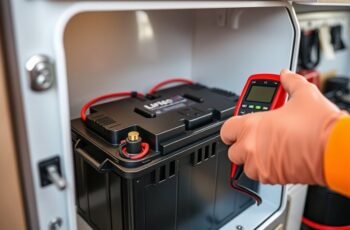
Imagine a delicate balance beam, where even slight deviations can tip the entire system into inefficiency or damage. This is precisely what managing the Lifepo4 charging voltage entails. Ensuring each cell stays within the ideal voltage range is critical for safety and longevity. To master this, understanding the specific voltage limits and phases involved becomes essential. Let’s explore how precise voltage management can safeguard your battery’s performance over time.
Key Takeaways
- The optimal charge voltage per LiFePO4 cell is around 3.65V, with full charge at approximately 14.6V in a 12V system.
- Charging phases include bulk (up to 3.65V per cell), absorption, and float, each with specific voltage limits.
- Regularly monitor and calibrate voltage settings using accurate tools to prevent overcharging or undercharging.
- Overvoltage beyond 3.65V per cell causes degradation, while undervoltage impairs cell balancing and lifespan.
- Use a LiFePO4 voltage chart to ensure proper charging thresholds and maintain battery health.
What Is the Optimal Voltage Range for Lifepo4 Charging?
Understanding the ideal voltage range for Lifepo4 charging is essential for maximizing battery lifespan and performance. The recommended voltage range typically spans from 3.2V to 3.65V per cell, aligning with a full charge at approximately 14.6V for a 12V system. Operating within this range preserves battery capacity and ensures consistent charging speed, preventing overvoltage stress that can degrade cells over time. Maintaining proper voltage levels *enhances* the balance between rapid charging and longevity, enabling efficient energy transfer without risking damage. Precise adherence to these voltage limits ensures that the battery maintains its capacity over multiple cycles, providing reliable power output and consistent performance across its lifespan. Accurate voltage management is fundamental to *effective* Lifepo4 battery operation.
Understanding the Charging Phases and Voltage Limits
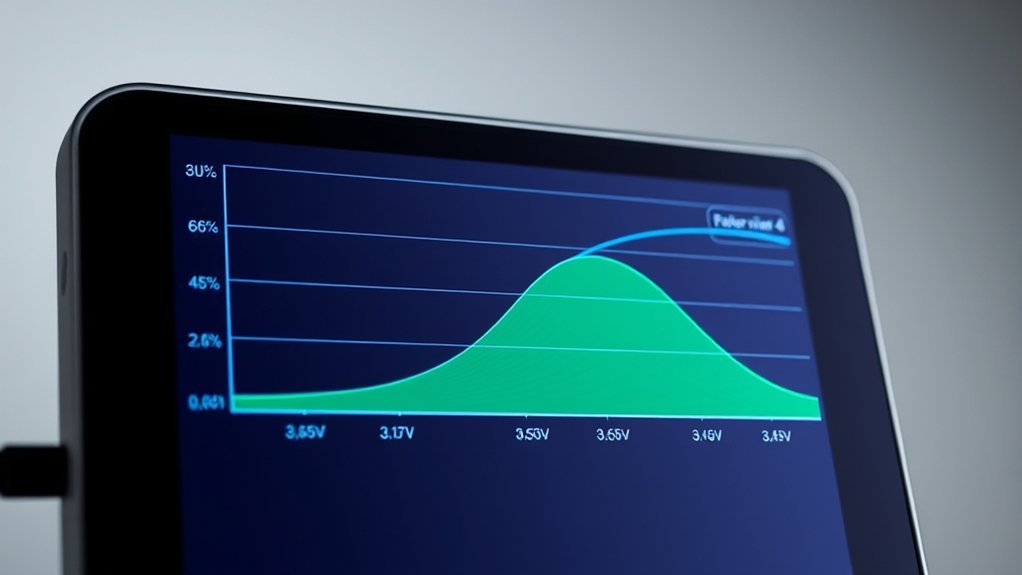
Charging a Lifepo4 battery involves distinct phases, each with specific voltage and current characteristics that maximize safety and efficiency. Understanding these phases is essential for proper voltage calibration and maintaining battery chemistry integrity.
Proper charging phases ensure safe operation and extend LiFePO4 battery lifespan.
- Bulk Phase: The charger supplies maximum current at a set voltage, typically around 3.65V per cell, initiating rapid charge without exceeding voltage limits.
- Absorption Phase: Voltage is held steady while current decreases, allowing full cell balancing aligned with the battery chemistry.
- Float or Maintenance Phase: Voltage drops slightly below the full charge voltage, preventing overcharge and ensuring longevity.
- Equalization: Occasionally used for balancing cells, this involves a controlled voltage slightly above the absorption phase, strictly within voltage limits.
Adhering to these phases ensures safe operation and prolonged lifespan.
How to Set and Monitor Your Lifepo4 Charging Voltage Chart
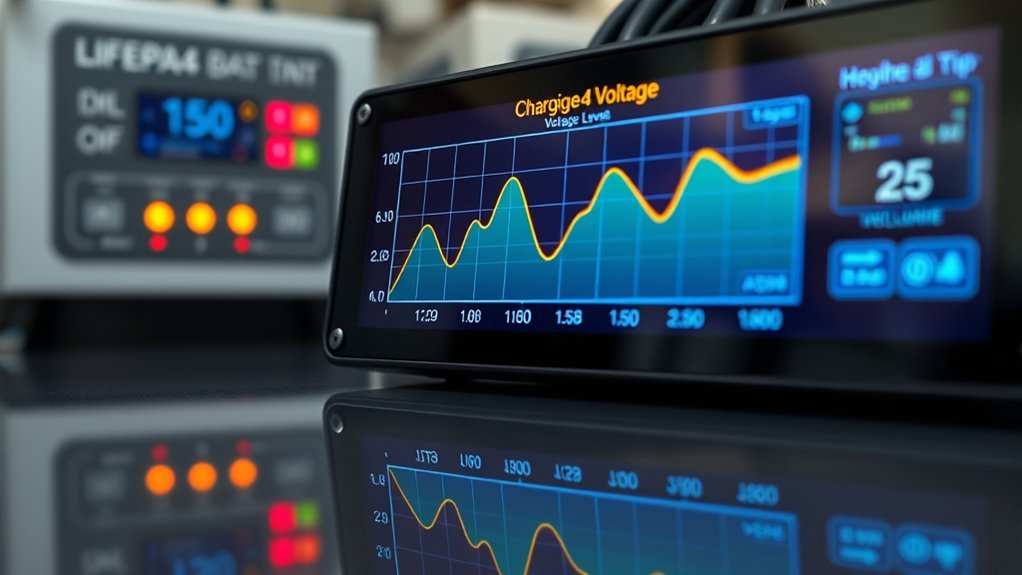
To accurately set and monitor your Lifepo4 charging voltage chart, we must first establish precise voltage targets for each charging phase based on the battery’s specifications, typically around 3.65V per cell during bulk and absorption. Precise voltage settings are essential for maintaining voltage stability and maximizing battery capacity utilization. We recommend configuring your charger to adhere strictly to these voltage limits, ensuring consistent charge quality and preventing overcharging. Monitoring involves regularly checking voltage levels with a multimeter or a compatible BMS, especially during the absorption phase. Maintaining accurate voltage readings helps detect potential issues early, preserving battery health and ensuring safe operation. Properly setting and monitoring these voltage targets guarantees maximum battery capacity and voltage stability over its lifespan.
Common Mistakes That Affect Lifepo4 Battery Voltage Settings
Missteps in setting and monitoring Lifepo4 battery voltage can lead to reduced lifespan, diminished capacity, or safety hazards. Incorrect voltage calibration is a primary factor.
- Overlooking manufacturer specifications: Ignoring recommended voltage ranges compromises battery safety and longevity.
- Using inaccurate measuring equipment: Faulty or poorly calibrated tools can produce misleading readings, risking improper voltage settings.
- Neglecting temperature effects: Failing to adjust voltage settings based on temperature fluctuations can cause overcharging or undervoltage conditions.
- Inconsistent monitoring practices: Sporadic checks hinder early detection of voltage deviations, increasing safety risks and accelerating capacity loss.
Ensuring precise voltage calibration and attentive monitoring are essential to optimize Lifepo4 performance and safety. Avoiding these common mistakes safeguards both the battery’s health and user safety.
Tips for Maintaining Battery Health Through Proper Voltage Management
Maintaining ideal battery health requires careful voltage management, as improper voltage levels can accelerate degradation or pose safety risks. To prevent battery degradation, precise voltage calibration is essential, ensuring each cell remains within best charging and discharging limits. Regularly verify voltage readings with calibrated tools to detect early deviations that could harm the battery. Avoid overcharging beyond the recommended voltage, which accelerates capacity loss and thermal stress. Similarly, undercharging can lead to incomplete cell balancing, affecting longevity. Consistent monitoring of voltage levels allows us to implement timely adjustments, preserving capacity and safety. Proper voltage management minimizes stress on the battery, extending its lifespan and maintaining performance. Overall, disciplined voltage calibration and adherence to recommended charging voltages are key to durable, safe LiFePO4 battery operation.
Frequently Asked Questions
How Does Temperature Affect Lifepo4 Charging Voltage?
Temperature influences Lifepo4 charging voltage due to battery chemistry sensitivities; higher temperatures can increase voltage thresholds, while lower temperatures decrease them. Effective thermal management guarantees ideal charging, preventing overvoltage or undercharging, and maintains battery longevity and safety.
Can Overcharging Lifepo4 Batteries Cause Permanent Damage?
Overcharging LiFePO4 batteries jeopardizes battery safety and can cause permanent damage by exceeding voltage thresholds, leading to capacity loss or thermal runaway. Proper voltage optimization and adherence to manufacturer specifications are vital for maintaining long-term battery health.
What Are the Signs of Improper Voltage Settings?
Sure, because ignoring battery safety and voltage troubleshooting never leads to problems, signs of improper voltage settings include overheating, voltage fluctuations, reduced capacity, and warning indicators. We monitor these carefully to prevent damage and guarantee ideal Lifepo4 battery performance.
Are There Specific Chargers Recommended for Lifepo4 Batteries?
We recommend chargers specifically designed for LiFePO4 battery chemistry, as they optimize charging cycles and voltage profiles, ensuring safe, efficient operation and prolonging battery life. Proper chargers prevent damage and maintain consistent performance across cycles.
How Often Should I Recalibrate My Voltage Monitoring System?
We recommend recalibrating our voltage monitoring system after every 50 charging cycles to guarantee voltage stability. Regular recalibration maintains accuracy, prevents misreads, and optimizes battery performance over time through precise voltage assessments.
Conclusion
In summary, careful control and consistent monitoring of your LiFePO4 voltage are essential for maximizing lifespan and maintaining peak performance. By diligently defining, detecting, and managing the designated voltage domains, we prevent premature wear and potential failures. Precision in planning and patience in practice ensure power, prolonging the battery’s life with minimal mishaps. Ultimately, disciplined dosing of voltage details delivers dependable, durable, and dynamic battery performance.