Many assume that simply charging a LiFePO4 battery is enough to guarantee peak performance, but the truth is that proper maintenance involves a nuanced understanding of its chemistry and operational limits. By carefully monitoring voltage, temperature, and physical condition, we can greatly extend its lifespan and safety. Yet, the intricacies of storage, charging protocols, and troubleshooting are often overlooked. Exploring these aspects reveals essential practices that could ultimately define the battery’s long-term reliability and efficiency.
Key Takeaways
- Regularly monitor voltage, temperature, and physical condition to detect early signs of damage or issues.
- Maintain charge levels between 20-80% and avoid deep discharges to prolong battery life.
- Use proper chargers with correct cutoff voltage and limit fast charging to prevent overheating.
- Store batteries in a cool, dry place at around 50% charge, avoiding extreme temperatures.
- Inspect terminals, clean surfaces gently, and address any damage or swelling promptly for safety.
How Do Lifepo4 Batteries Work and Why Proper Maintenance Matters
LiFePO4 batteries operate through the movement of lithium ions between the anode and cathode during charge and discharge cycles, providing a stable and efficient energy storage mechanism. This electrochemical process guarantees high cycle life and thermal stability, making maintenance critical for peak performance. Proper maintenance reduces degradation, extending battery lifespan and minimizing waste. It also supports sustainable practices such as battery recycling, which is essential for mitigating environmental impact by recovering valuable materials and reducing landfill waste. Understanding the internal chemistry emphasizes the importance of preventing overcharging and deep discharges. Maintaining the battery’s health not only preserves its efficiency but also aligns with environmental responsibility, highlighting the interconnectedness of technical care and ecological sustainability in energy storage systems.
How to Monitor Voltage and State of Charge Effectively

To effectively monitor the voltage and state of charge (SoC) of a battery, it’s essential to use precise measurement tools and adopt systematic procedures. Consistently checking voltage stability helps identify early signs of capacity loss or imbalance, guaranteeing peak performance. Accurate voltmeters or smart monitors with integrated charge indicators provide real-time data, allowing us to track voltage fluctuations and detect deviations from normal operating ranges. By correlating voltage readings with established SoC benchmarks, we can determine the battery’s remaining capacity more precisely. Maintaining tight control over voltage stability is vital to prolong battery life and prevent potential damage. Regular monitoring with reliable tools ensures informed decision-making, supporting safe and efficient operation of the Lifepo4 battery system.
Why Avoiding Overcharging and Deep Discharging Is Crucial
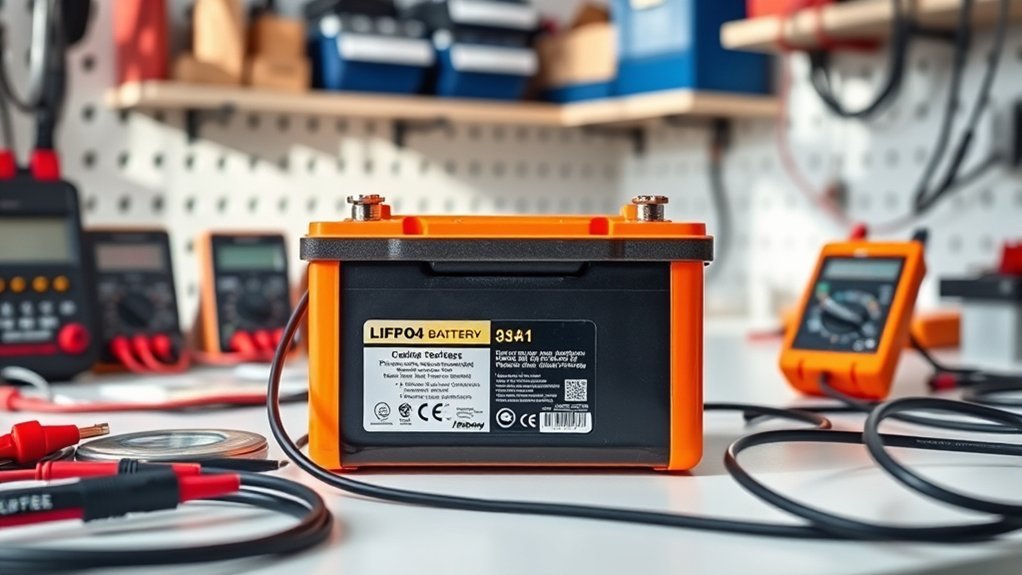
Avoiding overcharging and deep discharging is essential because these practices directly impact battery integrity and longevity. Proper management prevents internal damage and guarantees the battery maintains ideal performance over time. By adhering to these guidelines, we can considerably extend the lifespan of Lifepo4 batteries and preserve their efficiency.
Prevents Battery Damage
Overcharging and deep discharging can considerably compromise the lifespan and safety of a LiFePO4 battery. These practices accelerate internal degradation, leading to reduced capacity and potential safety hazards. Proper management guarantees the battery remains within ideal voltage ranges, preventing irreversible damage. Avoiding overcharge and deep discharge also supports sustainable practices like battery recycling, minimizing environmental impact. Key considerations include:
- Using appropriate charge controllers to prevent overvoltage
- Regularly monitoring state of charge (SOC)
- Implementing protective circuitry in battery systems
- Avoiding prolonged storage at extreme states of charge
- Adopting proper maintenance routines to extend lifespan
Extends Battery Life
Why does preventing overcharging and deep discharging considerably extend the lifespan of a LiFePO4 battery? Overcharging stresses the cell’s internal chemistry, accelerating capacity fade and increasing the risk of thermal runaway, while deep discharging causes irreversible electrode degradation. Both scenarios reduce overall cycle life, necessitating earlier battery replacement and increasing waste. By maintaining appropriate charge levels, we not only prolong the battery’s functional life but also facilitate responsible Battery Recycling, minimizing environmental impact. Proper charge management reduces the frequency of disposal, decreasing hazardous waste and conserving resources. Ultimately, avoiding these extremes preserves battery integrity, supports sustainable practices, and contributes to a more environmentally conscious approach to energy storage.
Maintains Optimal Performance
Maintaining ideal performance in a LiFePO4 battery requires careful regulation of its charge levels, as fluctuations outside the recommended range can considerably impair its efficiency. Proper management of charge cycles preserves the integrity of the battery chemistry, preventing degradation. Overcharging can cause voltage stress, leading to capacity loss, while deep discharging risks irreversible damage to the cell structure. To sustain maximum performance, we emphasize:
- Avoid exceeding the recommended voltage limits
- Prevent deep discharges below safe voltage thresholds
- Use a compatible charger with precise voltage regulation
- Monitor charge levels regularly
- Limit the number of full charge-discharge cycles
Best Practices for Safe and Proper Battery Storage
Proper storage of LiFePO4 batteries is essential to guarantee their longevity and safety. We recommend storing batteries in a cool, dry environment with a stable temperature between 0°C and 25°C to minimize capacity loss. Maintaining a storage charge level around 50% reduces stress and prolongs lifespan, especially if the battery will be idle for extended periods. Avoid exposing batteries to direct sunlight or high humidity, which can accelerate degradation. When considering battery recycling, ensure proper disposal practices to prevent environmental harm. Additionally, store batteries away from sources of heat that could increase charging speed unintentionally, risking thermal runaway. Carefully monitoring storage conditions preserves capacity and safety, enabling ideal performance over the battery’s lifespan while aligning with best practices for responsible disposal and reuse.
How to Keep Your Lifepo4 Battery Clean and Inspect for Damage
Regularly cleaning and inspecting your LiFePO4 battery is essential to guarantee ideal performance and safety. Surface cleaning involves removing dust, dirt, and corrosion to prevent conductivity issues and overheating. Damage inspection focuses on identifying cracks, swelling, or corrosion that could compromise safety or efficiency. Key practices include:
- Using a soft brush or cloth for surface cleaning
- Avoiding harsh chemicals that may damage the casing
- Checking for any physical deformities or leaks
- Inspecting terminals for corrosion or loose connections
- Monitoring for swelling or discoloration indicating internal damage
Using the Right Charging Equipment and Settings for Longevity
Selecting the appropriate charging equipment and configuring ideal settings are critical steps in extending the lifespan of your LiFePO4 battery. Proper chargers ensure correct voltage and current levels, preventing overcharging or undercharging, which can degrade cell chemistry over time. Using chargers compatible with LiFePO4 chemistry minimizes environmental impact by reducing the need for early battery recycling. The following table highlights key considerations:
| Consideration | Importance | Impact on Longevity |
|---|---|---|
| Correct voltage settings | Prevents overvoltage damage | Extends battery life |
| Appropriate current | Avoids thermal stress | Maintains capacity |
| Temperature regulation | Prevents overheating | Preserves cell integrity |
| Charger compatibility | Ensures safe operation | Reduces environmental footprint |
Adhering to these parameters optimizes longevity, minimizes waste, and supports sustainable battery recycling practices.
Troubleshooting Common Lifepo4 Battery Issues and When to Seek Help
When a LiFePO4 battery exhibits performance issues, prompt identification and diagnosis are essential to prevent further damage and guarantee safety. Common signs include reduced capacity, uneven charging, overheating, swelling, or rapid discharge. Troubleshooting involves checking for proper connections, voltage levels, and signs of physical damage. If issues persist, professional testing may be necessary. Addressing problems early can help extend the battery’s lifespan and reduce environmental impact by promoting responsible battery recycling. Ignoring faults risks hazardous failures and contributes to electronic waste. Always prioritize safety when handling damaged batteries. Recognizing these issues promptly minimizes environmental footprint and supports sustainable disposal practices, ensuring that materials are responsibly recycled rather than discarded prematurely.
Tips for Extending Your Lifepo4 Battery’s Lifespan Over Time
Maintaining ideal charging practices guarantees battery chemistry stability and minimizes capacity loss over time. Additionally, storing the battery under appropriate conditions prevents degradation caused by temperature fluctuations and humidity. By adhering to these principles, we can considerably improve the longevity and performance of Lifepo4 batteries.
Proper Charging Practices
Proper charging practices are essential for maximizing the lifespan of a LiFePO4 battery, as improper charging can accelerate capacity loss and reduce overall performance. Maintaining ideal charge levels preserves battery chemistry integrity and prolongs effective charging cycles. To achieve this, avoid frequent deep discharges and avoid exceeding 100% charge, which stresses the battery. Using chargers compatible with LiFePO4 chemistry ensures proper voltage regulation. Additionally, limiting high-current fast charging can reduce stress on the cells.
- Maintain charge between 20-80% for longevity
- Use a charger with a proper cutoff voltage
- Avoid deep discharges below 20%
- Minimize frequent full charging cycles
- Regularly monitor voltage and temperature during charging
Optimal Storage Conditions
Effective storage conditions play a vital role in preserving the performance and longevity of LiFePO4 batteries. Environmental factors such as temperature, humidity, and exposure to sunlight considerably impact battery stability over time. For ideal storage, we recommend maintaining a cool, dry environment with temperatures around 0°C to 25°C, avoiding extreme heat or cold that accelerates capacity loss. Additionally, storing batteries at a partial state of charge—around 50%—reduces stress on cells and prolongs lifespan. Proper storage also facilitates battery recycling, ensuring environmentally responsible disposal when the battery reaches end-of-life. By controlling environmental factors and adhering to recommended storage practices, we can extend LiFePO4 battery lifespan and minimize environmental impact, promoting sustainable energy use and responsible recycling efforts.
Frequently Asked Questions
Can Lifepo4 Batteries Be Used in Extreme Weather Conditions?
Lifepo4 batteries exhibit good temperature resilience and weather adaptation, enabling safe operation in many extreme conditions. However, we recommend proper insulation and temperature management to optimize performance and longevity in severe weather situations.
How Often Should I Calibrate My Lifepo4 Battery Monitor?
We recommend calibrating your Lifepo4 battery monitor every three to six months, as proper calibration optimizes battery lifespan and accuracy. Regular calibration helps guarantee precise readings, enabling better management and preventing potential issues over your battery’s lifecycle.
Are There Specific Brands of Chargers Recommended for Lifepo4 Batteries?
We recommend chargers with proven compatibility for Lifepo4 batteries, such as Victron, Renogy, or BattSmart. These brands offer reliable performance, ensuring safe charging, ideal battery lifespan, and adherence to Lifepo4-specific charging profiles for maximum efficiency.
What Are Signs of a Failing Lifepo4 Battery?
Like a vintage radio, a failing Lifepo4 battery shows reduced capacity, increased internal resistance, and uneven voltage discharge. Poor charging habits shorten its lifespan, so monitoring voltage and temperature helps identify early signs of degradation.
Is It Necessary to Cycle the Battery Regularly for Maintenance?
We believe regular cycling enhances battery longevity by preventing capacity loss, and maintaining proper charging habits avoids stress and degradation, ensuring peak performance. Consistent cycling isn’t mandatory but recommended for maximizing lifespan and ensuring reliable energy storage over time.
Conclusion
By following these maintenance guidelines, we guarantee our LiFePO4 batteries perform reliably and last longer. Proper monitoring, careful handling, and adherence to recommended practices are essential for maximum efficiency and safety. Remember, a stitch in time saves nine—address issues early and maintain consistent care. This proactive approach not only safeguards our investment but also promotes sustainable energy use, reinforcing that attention to detail today pays dividends in the long run.