While it’s tempting to assume that all batteries can be charged similarly, LiFePO4 batteries require precise handling to guarantee safety and longevity. Proper charging involves understanding specific voltage and current parameters and selecting the right equipment. Without adherence to these guidelines, you risk damaging the battery or compromising performance. To fully grasp the necessary steps and avoid common pitfalls, it’s essential to explore the detailed procedures that follow.
Key Takeaways
- Use a charger specifically designed for LiFePO4 batteries, supporting about 3.65V per cell and appropriate current.
- Set the charger to the recommended voltage and current limits before starting the charging process.
- Disconnect the battery promptly once it reaches full charge to prevent overcharging.
- Monitor temperature and voltage during charging to avoid overheating and ensure safety.
- Follow proper safety practices, including ventilation and wearing protective equipment, during the charging process.
How LiFePO4 Batteries Differ From Traditional Batteries
What sets LiFePO4 batteries apart from traditional lead-acid or nickel-based batteries is their unique chemical composition and electrochemical properties. Their battery chemistry involves lithium iron phosphate as the cathode material, which provides a stable and safe electrochemical environment. This stability results in lower risks of thermal runaway and reduces the need for complex cooling systems, enhancing charging safety. Unlike lead-acid batteries, LiFePO4 cells exhibit a flat voltage profile during discharge, allowing more accurate state-of-charge estimation. Additionally, their chemical makeup enables more efficient charge and discharge cycles, with minimal capacity loss over time. These attributes make LiFePO4 batteries not only safer but also more durable, offering consistent performance with less maintenance compared to traditional alternatives.
Understanding the Proper Charging Voltage and Current Settings
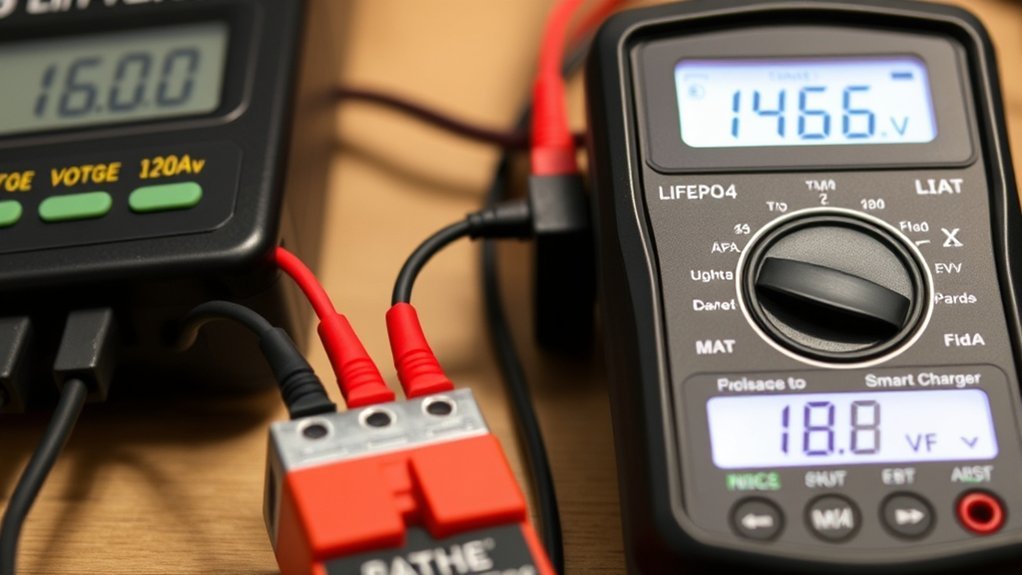
To guarantee peak performance and longevity of LiFePO4 batteries, it’s essential to set the correct charging voltage and current levels. Proper voltage regulation ensures the battery charges within its safe limits, typically around 3.65V per cell, preventing overcharging that can compromise safety and lifespan. Charging safety depends on adhering to manufacturer-recommended voltage and current parameters; exceeding these can cause thermal issues or damage. The current should be set according to the battery’s capacity, usually 0.5C to 1C, to optimize charging speed without risking overheating. Precise voltage regulation and controlled current flow are critical for maintaining battery health, ensuring safe operation, and maximizing efficiency during the charging process.
Choosing the Right Charger for Your LiFePO4 Battery
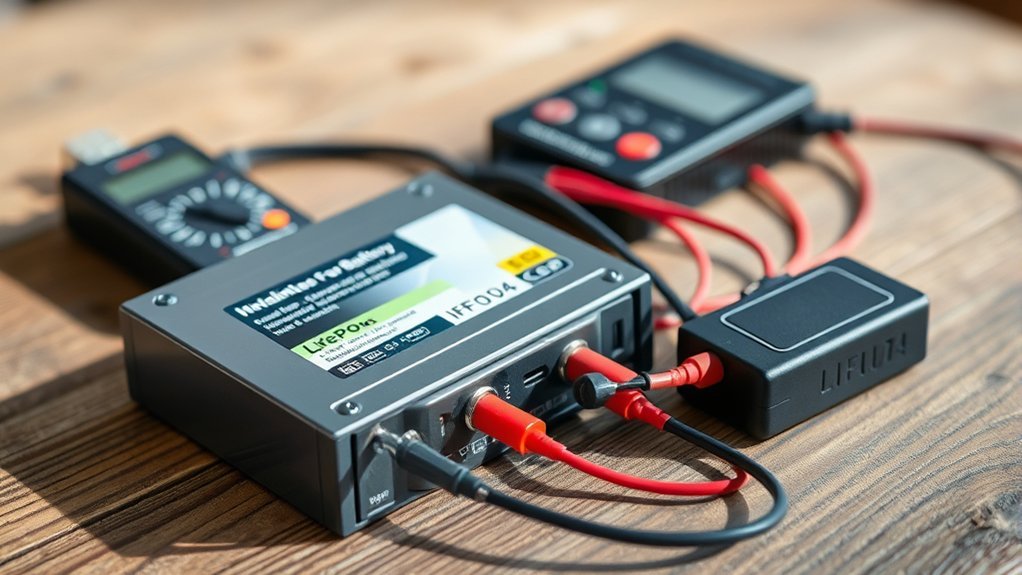
Selecting the appropriate charger is essential to guaranteeing your LiFePO4 battery charges safely and efficiently. The charger must match the battery chemistry, specifically designed for LiFePO4 chemistry, to prevent overcharging and thermal runaway. A compatible charger with precise voltage and current regulation ensures ideal charging speed without compromising battery longevity. It’s important to choose a charger that supports the recommended charging voltage (around 3.65V per cell) and the appropriate current, typically 0.5C to maximize charging speed while maintaining safety. Using a charger tailored for LiFePO4 batteries guarantees stable operation, prolongs cycle life, and minimizes risks associated with incompatible charging profiles. Proper selection of the charger is critical for achieving efficient, safe, and reliable battery performance.
Step-by-Step Guide to Safely Charging Your LiFePO4 Battery
To guarantee safe charging of your LiFePO4 battery, we start with selecting the appropriate charger that matches the battery specifications. Next, we follow correct charging procedures, including proper voltage and current limits, to prevent damage. Throughout the process, continuous monitoring allows us to detect any abnormalities and maintain ideal safety.
Proper Charger Selection
Choosing the correct charger is crucial to guarantee the safe and efficient operation of your LiFePO4 battery. A compatible charger ensures ideal charging speed without risking overcharge or thermal issues. It’s essential to select a charger with a voltage and current rating matching the battery’s specifications. Using an improper charger can hinder battery recycling efforts, as it may lead to damage or reduced lifespan. Fast charging should be approached cautiously; a charger that provides the right balance between charging speed and safety preserves battery health. Always verify that the charger has built-in protections, such as overvoltage and overcurrent safeguards. Proper charger selection directly impacts battery longevity and safety, making it a critical step in responsible LiFePO4 battery management.
Correct Charging Procedures
Ensuring a safe and effective charging process for your LiFePO4 battery requires following specific procedures meticulously. First, set the charger to the recommended voltage and current specified by the manufacturer. Avoid overcharging by disconnecting the battery once it reaches full capacity to prevent damage and extend lifespan. Use appropriate safety equipment and ensure proper ventilation during charging. When the battery reaches the end of its lifecycle, responsible battery disposal is critical to minimize environmental impact. Never discard LiFePO4 batteries in household trash, as improper disposal can lead to environmental contamination. Instead, follow local regulations for recycling or disposal. Precise adherence to charging procedures not only safeguards your equipment but also promotes environmentally responsible practices.
Monitoring During Charging
Monitoring the charging process of your LiFePO4 battery is vital to guarantee safety and ideal performance. Due to the specific battery chemistry of LiFePO4, precise monitoring ensures that voltage and temperature stay within safe parameters. Using a high-quality battery management system (BMS), we can track real-time voltage, current, and temperature, preventing overcharge and thermal runaway. During charging, it’s essential to observe that the voltage per cell does not exceed 3.65V, maintaining maximum charging safety. Continuous monitoring helps detect any irregularities early, avoiding potential damage. Accurate data logging and alarms allow us to intervene promptly if unsafe conditions arise. Adhering to these monitoring practices ensures the longevity of the battery while prioritizing safety during the entire charging process.
Common Mistakes to Avoid When Charging LiFePO4 Batteries
While it’s tempting to rely solely on generic chargers, neglecting proper charging practices can severely reduce LiFePO4 battery lifespan and performance. Common mistakes include overcharging, which accelerates degradation, and undercharging, leading to capacity loss. Using incompatible chargers can cause voltage irregularities, risking thermal runaway. Failing to monitor temperature during charging may result in damage and safety hazards. Additionally, improper disposal hampers battery recycling efforts, increasing environmental impact. To minimize these issues, always use chargers designed for LiFePO4 chemistry and follow recommended voltage and current parameters. Proper handling preserves battery health and supports environmentally responsible recycling practices, reducing waste and pollution.
| Mistake | Consequence |
|---|---|
| Overcharging | Capacity loss, safety risk |
| Using incompatible chargers | Battery damage, reduced lifespan |
| Ignoring temperature limits | Thermal runaway, safety hazards |
Monitoring and Maintaining Your Battery During Charging
During the charging process, it’s essential to actively observe your LiFePO4 battery’s voltage, temperature, and current to prevent damage and guarantee safety. Continuous monitoring guarantees the battery operates within ideal parameters, reducing risks of thermal runaway or overvoltage. Maintaining proper charge levels extends battery life and supports effective battery recycling, minimizing environmental impact. Accurate temperature measurement prevents overheating, which can accelerate degradation or cause safety hazards. Regularly checking current flow helps detect abnormal conditions early. Proper monitoring also encourages responsible disposal and recycling practices, reducing environmental harm. By keeping a close eye on these parameters, we ensure safe, efficient charging while promoting sustainability through conscientious battery management and recycling efforts.
Troubleshooting Charging Issues and Ensuring Longevity
To guarantee your LiFePO4 battery remains reliable over time, it’s essential to troubleshoot charging issues promptly and implement strategies to extend its lifespan. Common problems include inconsistent charging currents or voltage irregularities, which can lead to capacity loss. Regularly verify charger compatibility and confirm proper voltage regulation to prevent overcharging or deep discharges. Addressing these issues early preserves battery health and reduces the need for premature replacement, supporting sustainable practices like battery recycling. Proper maintenance minimizes environmental impact by decreasing waste and hazardous disposal. Additionally, monitoring charging cycles and avoiding extreme temperatures enhance longevity. Implementing these troubleshooting methods helps maintain peak performance, prolongs service life, and promotes environmentally responsible management of LiFePO4 batteries.
Frequently Asked Questions
Can Lifepo4 Batteries Be Charged With Solar Panels?
Yes, Lifepo4 batteries, known for their safe and stable battery chemistry, are compatible with solar panels. We recommend using a compatible charge controller to optimize solar compatibility and guarantee safe, efficient charging without damaging the battery.
How Long Does It Take to Fully Charge a Lifepo4 Battery?
Charging a Lifepo4 battery depends on its capacity and the charger’s current. Typically, it takes 4-8 hours, considering ideal charging cycles, but overcharging risks reduce lifespan, so precise control guarantees efficiency and safety.
Is It Necessary to Balance Lifepo4 Batteries Regularly?
We believe regular balancing is essential for ideal Lifepo4 battery maintenance, ensuring cells remain equal in voltage. Adhering to safety precautions during balancing prevents potential overcharge or damage, prolonging battery lifespan and maintaining performance.
What Temperature Is Optimal for Charging Lifepo4 Batteries?
We recommend charging LiFePO4 batteries at temperatures between 0°C and 45°C, as ideal for battery chemistry and charging safety. Staying within this range prevents damage, guarantees efficiency, and maintains the battery’s lifespan.
Can I Leave a Lifepo4 Battery on Charge Overnight?
You can leave a LiFePO4 battery on charge overnight safely if using a proper charger with charging safety features. This helps maintain battery lifespan while preventing overcharging, ensuring ideal performance and longevity through controlled, precise charging protocols.
Conclusion
In our experience, properly charging a LiFePO4 battery is like tending a delicate garden—attention to voltage, current, and monitoring guarantees healthy growth. Just as a gardener removes weeds to protect the plants, avoiding common mistakes and using the right charger safeguards your battery’s lifespan. When we follow these precise steps, our batteries perform reliably, much like a well-tended garden yielding a bountiful harvest—long-lasting, efficient, and safe.