When comparing LiFePO4 and Li-ion battery technologies, it’s crucial to take into account their distinct safety, performance, and application profiles. While LiFePO4 offers notable advantages in stability and lifespan, Li-ion batteries excel in energy density and compactness. Understanding these differences can influence critical choices for various projects. As we analyze their features and limitations, you’ll gain insights into which battery type best suits your specific needs and long-term goals.
Key Takeaways
- LiFePO4 offers superior thermal stability and safety, reducing risks of overheating and fires compared to Li-ion batteries.
- Li-ion batteries have higher energy density, making them more suitable for portable electronics and space-constrained applications.
- LiFePO4 batteries have longer cycle life (>2,000 cycles) and degrade slower, providing greater durability and lifespan.
- LiFePO4 performs better across a wider temperature range and is more environmentally friendly due to lower toxicity.
- Li-ion batteries are generally more cost-effective initially but incur higher long-term replacement and maintenance costs.
How Do LiFePO4 and Li-Ion Batteries Differ in Safety Features?
While both LiFePO4 and Li-ion batteries are widely used in various applications, their safety features differ considerably due to their chemical compositions. LiFePO4 batteries inherently offer greater thermal stability, reducing risks like thermal runaway and fires. This stability stems from their chemical structure, which is less prone to decomposition under stress. In contrast, Li-ion batteries with cobalt or nickel cathodes are more susceptible to overheating, requiring sophisticated battery manufacturing techniques to improve safety. Market adoption of LiFePO4 is often driven by safety considerations, especially in stationary and large-scale applications. Their safer chemistry simplifies integration and reduces the need for complex thermal management systems. Consequently, understanding these safety differences influences both industry standards and consumer confidence.
Comparing Lifespan and Cycle Life of LiFePO4 and Lithium-Ion Batteries
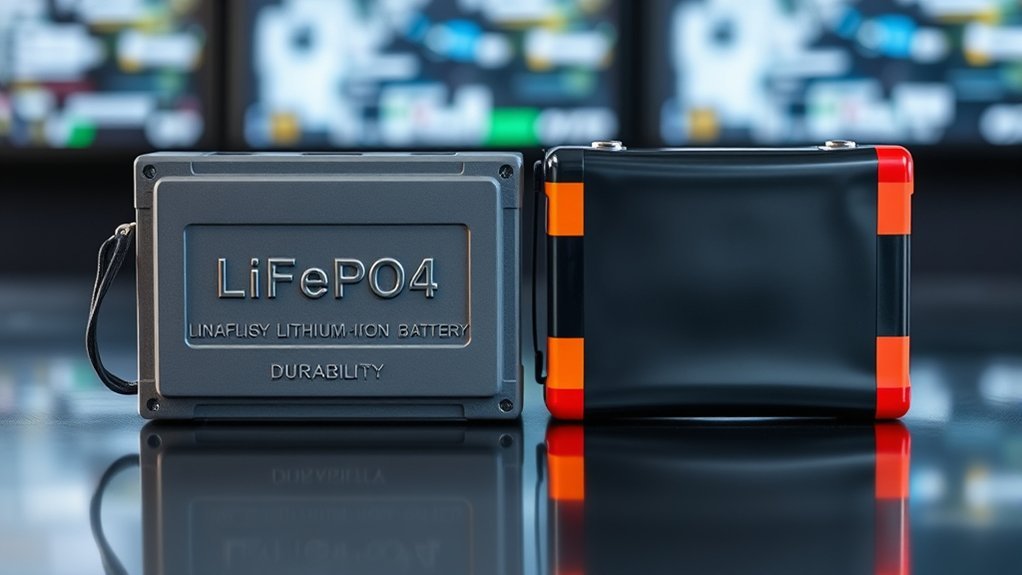
When comparing lifespan and cycle life, we focus on how long each battery type maintains its capacity under operational stresses. LiFePO4 batteries generally exhibit higher cycle counts before significant degradation, reflecting superior durability. Factors like temperature, charge rates, and depth of discharge critically influence their long-term performance and degradation trajectories.
Longevity and Durability
LiFePO4 batteries generally outperform lithium-ion counterparts in aspects of longevity and durability, primarily due to their chemical stability and structural robustness. Their inherent stability reduces degradation over repeated charge cycles, extending operational lifespan. During battery manufacturing, the stable chemistry minimizes the formation of harmful dendrites, which can cause internal damage and safety hazards. This durability translates into a higher cycle life, often surpassing 2,000 cycles with minimal capacity loss. Additionally, the robust chemistry enhances consumer safety by decreasing the risk of thermal runaway and related failures. Overall, the combination of chemical resilience and manufacturing quality guarantees that LiFePO4 batteries maintain performance over longer periods, making them a more reliable and durable choice for demanding applications.
Cycle Count Capacity
LiFePO4 batteries generally offer a markedly higher cycle count capacity compared to lithium-ion counterparts, which directly correlates with a longer lifespan. This advantage stems from their distinct battery chemistry, where the stable olivine structure minimizes structural degradation over repeated cycles. Additionally, manufacturing processes for LiFePO4 cells typically emphasize precision in electrode material synthesis, reducing internal stress and extending cycle life. In contrast, lithium-ion batteries with cobalt or nickel chemistries often experience more rapid capacity fade due to less stable cathode materials. The inherent stability of LiFePO4’s chemistry allows it to endure more charge-discharge cycles, often exceeding 2,000 to 5,000 cycles, whereas lithium-ion batteries usually range between 500 and 1,500 cycles. This superior cycle capacity enhances overall durability and long-term performance.
Degradation Factors
The factors contributing to battery degradation profoundly influence the overall lifespan and cycle life of both LiFePO4 and lithium-ion batteries. Key elements include battery packaging, which affects thermal management and mechanical stability, and manufacturing processes that determine material quality and internal resistance. LiFePO4 batteries generally exhibit slower degradation due to more stable chemistry and less susceptibility to thermal stress, while lithium-ion batteries are more vulnerable to capacity fade from repeated cycling. Variations in manufacturing, such as electrode formulation and separator quality, directly impact degradation rates. Proper battery packaging minimizes internal stress and prolongs life, whereas subpar processes can accelerate capacity loss. Understanding these degradation factors enables more accurate lifespan predictions and optimized battery designs for specific applications.
Which Battery Technology Performs Better in Extreme Temperatures?
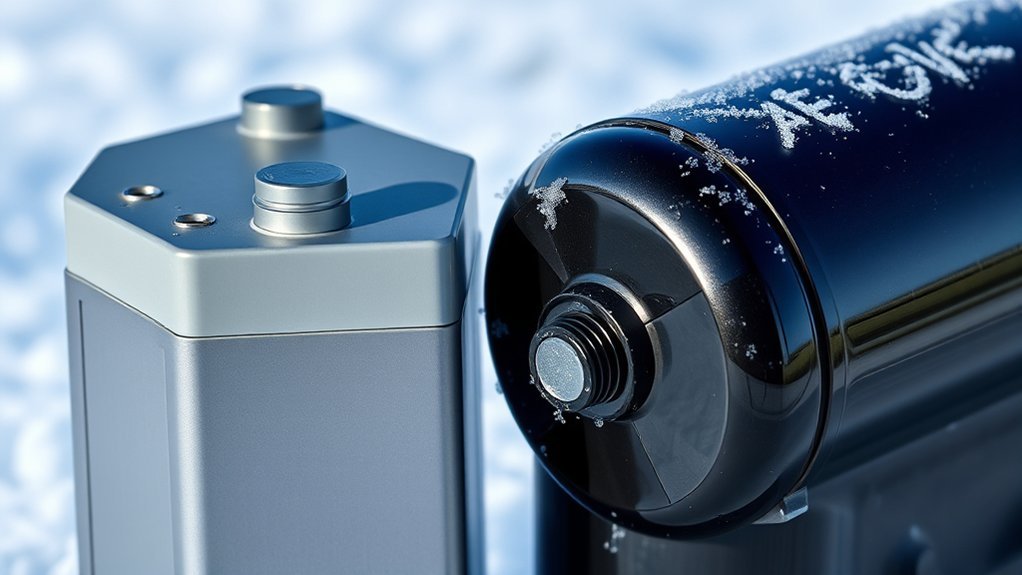
When evaluating battery performance in extreme temperatures, we focus on their temperature tolerance range and how stable their output remains under such conditions. Lifepo4 batteries generally maintain consistent performance at higher and lower extremes compared to lithium-ion batteries, which are more sensitive to temperature fluctuations. Understanding these differences helps determine which technology offers more reliable operation in challenging environments.
Temperature Tolerance Range
How well do these battery technologies withstand extreme temperatures? Lifepo4 batteries exhibit superior thermal stability and temperature resilience, maintaining performance across a broader range. Li-ion batteries, however, are more sensitive to temperature fluctuations, risking capacity loss and thermal runaway outside ideal conditions. The following table illustrates their temperature tolerance:
| Battery Type | Operating Range (°C) | Approximate Degradation Thresholds |
|---|---|---|
| Lifepo4 | -20 to 60 | -20°C, significant capacity loss above 60°C |
| Li-ion | -10 to 45 | -10°C, degraded performance above 45°C |
| Lifepo4 | 0 to 55 | Less thermal stress, stable performance |
| Li-ion | 0 to 40 | Increased risk of instability |
| Both | -40 to 70 | Lifepo4 better suited for extreme conditions |
This comparison underscores Lifepo4’s enhanced thermal stability and resilience in extreme environments.
Performance Stability Under Extremes
Building on their thermal properties, evaluating how each battery type maintains performance under extreme temperatures reveals significant differences. Li-ion batteries tend to degrade more rapidly in high or low temperatures, with performance losses occurring due to electrolyte instability and electrode degradation, which is influenced by battery manufacturing quality. Conversely, Lifepo4 batteries exhibit superior stability in extreme conditions, thanks to their robust chemistry and stable cathode material. This stability makes Lifepo4 more suitable for energy storage systems operating in variable climates, where temperature fluctuations are common. The ability to sustain capacity and cycle life under thermal stress highlights Lifepo4’s advantage in demanding environments. Consequently, for applications requiring reliable performance across a wide temperature spectrum, Lifepo4 batteries provide a more consistent and durable solution.
The Size, Weight, and Energy Density Differences Between LiFePO4 and Li-Ion
Although both LiFePO4 and Li-Ion batteries serve similar energy storage functions, they differ markedly in size, weight, and energy density. Li-Ion batteries typically offer higher energy density due to their advanced cathode chemistry, allowing more energy in a compact form. In contrast, LiFePO4 batteries are slightly larger and heavier for the same capacity, owing to their different cathode material and lower energy density. These differences are influenced by battery packaging and manufacturing techniques; Li-Ion cells often utilize more compact, intricate designs to maximize energy density, while LiFePO4 cells prioritize stability and safety, impacting their form factor. Consequently, these fundamental differences affect their suitability for various applications, balancing energy needs against size and weight constraints.
How Do Charging and Maintenance Requirements Vary for These Batteries?
While both LiFePO4 and Li-Ion batteries require proper charging protocols, their maintenance routines differ considerably due to chemical stability and operational traits. LiFePO4 batteries are more tolerant of overcharging and deep discharges, allowing for relaxed maintenance routines and less stringent charging protocols. In contrast, Li-Ion batteries demand precise charging protocols to prevent capacity loss and ensure safety, often requiring sophisticated BMS (Battery Management Systems) to monitor voltage, current, and temperature. Regular maintenance for LiFePO4 mainly involves periodic checks of terminals and ensuring balanced charging. Li-Ion batteries, however, necessitate strict routine inspections and calibration of protective circuitry. Understanding these distinctions helps optimize battery lifespan and performance, aligning maintenance routines with each technology’s inherent stability and operational demands.
Cost Analysis: Is LiFePO4 More Cost-Effective Than Lithium-Ion?
Evaluating the cost-effectiveness of LiFePO4 versus lithium-ion batteries requires a thorough examination of initial purchase prices, lifespan, and maintenance expenses. LiFePO4 batteries typically have higher upfront costs due to specialized battery manufacturing processes, but their longer cycle life—often exceeding 2000 cycles—reduces replacement frequency. This durability translates into lower total cost of ownership over time. In contrast, lithium-ion batteries generally feature lower initial costs but may incur higher maintenance and replacement expenses within their shorter lifespan. Recent energy storage trends indicate increasing adoption of LiFePO4 for large-scale applications, driven by declining manufacturing costs and improved safety profiles. Consequently, although initial costs are higher, LiFePO4’s extended longevity and decreasing manufacturing expenses can make it more cost-effective in the long run.
Ideal Use Cases for LiFePO4 vs. Traditional Lithium-Ion Batteries
LiFePO4 batteries are particularly well-suited for applications that prioritize safety, longevity, and stability, whereas traditional lithium-ion batteries excel in scenarios demanding high energy density and compact form factors. In terms of battery manufacturing, LiFePO4’s thermal stability reduces risks associated with thermal runaway, making it ideal for critical safety applications. Their longer cycle life benefits markets focused on durability, such as renewable energy storage and electric vehicles requiring extended lifespan. Conversely, lithium-ion batteries dominate portable electronics and applications where space constraints and weight are paramount, driven by their higher energy density. Market adoption reflects these distinctions; LiFePO4’s safety and stability foster trust in stationary and large-scale deployments, while traditional lithium-ion’s compactness sustains its prominence in consumer electronics. Each technology serves distinct niches aligned with their core strengths.
Environmental Impact and Recycling Considerations for Both Battery Types
The environmental impacts of battery production, use, and disposal are critical factors in evaluating their sustainability, with LiFePO4 and traditional lithium-ion batteries presenting distinct challenges and advantages. During battery manufacturing, LiFePO4’s lower toxicity reduces environmental hazards, whereas lithium-ion production often involves more intensive resource extraction. Regarding market adoption, LiFePO4’s longer lifespan diminishes waste, but its lower energy density may limit widespread use. Recycling considerations highlight that:
- Lithium-ion batteries require complex processes to recover valuable materials.
- LiFePO4 batteries are easier to recycle due to less hazardous components.
- Both types face challenges with proper disposal to prevent environmental contamination.
- Increasing recycling infrastructure is essential for sustainable lifecycle management.
Which Battery Technology Should You Choose for Your Next Project?
Choosing the right battery technology for your next project depends on balancing performance requirements, environmental considerations, and cost constraints. When evaluating Lifepo4 versus Li-Ion, it’s crucial to take into account how battery manufacturing processes impact scalability and reliability. Lifepo4 batteries typically offer superior thermal stability and longer cycle life, making them suitable for high-demand applications. Conversely, Li-Ion batteries dominate market adoption due to their higher energy density and widespread availability. Market trends suggest that ongoing advancements in battery manufacturing are narrowing performance gaps, but the choice ultimately hinges on specific project needs. If safety, longevity, and environmental factors are priorities, Lifepo4 may be preferable. For compact, high-capacity applications, Li-Ion remains the leading choice. Analyzing these factors guarantees an informed decision aligned with your project’s goals.
Frequently Asked Questions
How Do Charging Speeds Compare Between Lifepo4 and Li-Ion Batteries?
We find that Li-ion batteries typically have higher charging rates, enabling faster power delivery, whereas LiFePO4 batteries charge more slowly but offer better thermal stability and longevity, balancing power needs with safety and durability considerations.
Are Lifepo4 Batteries More Environmentally Friendly Than Li-Ion Batteries?
We believe LiFePO4 batteries are more eco-friendly due to their use of eco-friendly materials and safer recycling processes, reducing environmental impact. Their longer lifespan further minimizes waste, making them a sustainable choice compared to traditional Li-ion batteries.
What Are the Most Common Failure Modes for Each Battery Type?
We find that Li-ion batteries often fail due to capacity fade and thermal runaway, while Lifepo4 batteries typically experience voltage depression and cycle degradation; both face recycling challenges impacting overall battery lifespan and environmental sustainability.
Can Lifepo4 Batteries Be Used in High-Drain Applications Effectively?
We believe LiFePO4 batteries excel in high-drain applications due to their superior high current performance and reliable power delivery efficiency, making them ideal for demanding scenarios where consistent, rapid power output is essential.
How Does Thermal Management Differ for Lifepo4 and Li-Ion Systems?
We find that Lifepo4 batteries offer superior thermal stability, reducing risks during operation, while Li-ion systems require more extensive safety considerations due to higher thermal runaway potential, making thermal management essential for both, but especially critical for Li-ion.
Conclusion
In summary, choosing between LiFePO4 and Li-ion hinges on your specific needs. While LiFePO4 offers safer, sturdier, and longer-lasting solutions, Li-ion delivers denser, more compact power for portable pursuits. Consider your project’s parameters—performance, portability, and pocket—carefully. By weighing safety, lifespan, size, and cost, you can confidently select the superior battery suited to your particular purpose, ensuring maximum output and ongoing reliability.